🧭 ASOC and ASPM Orchestration Platforms
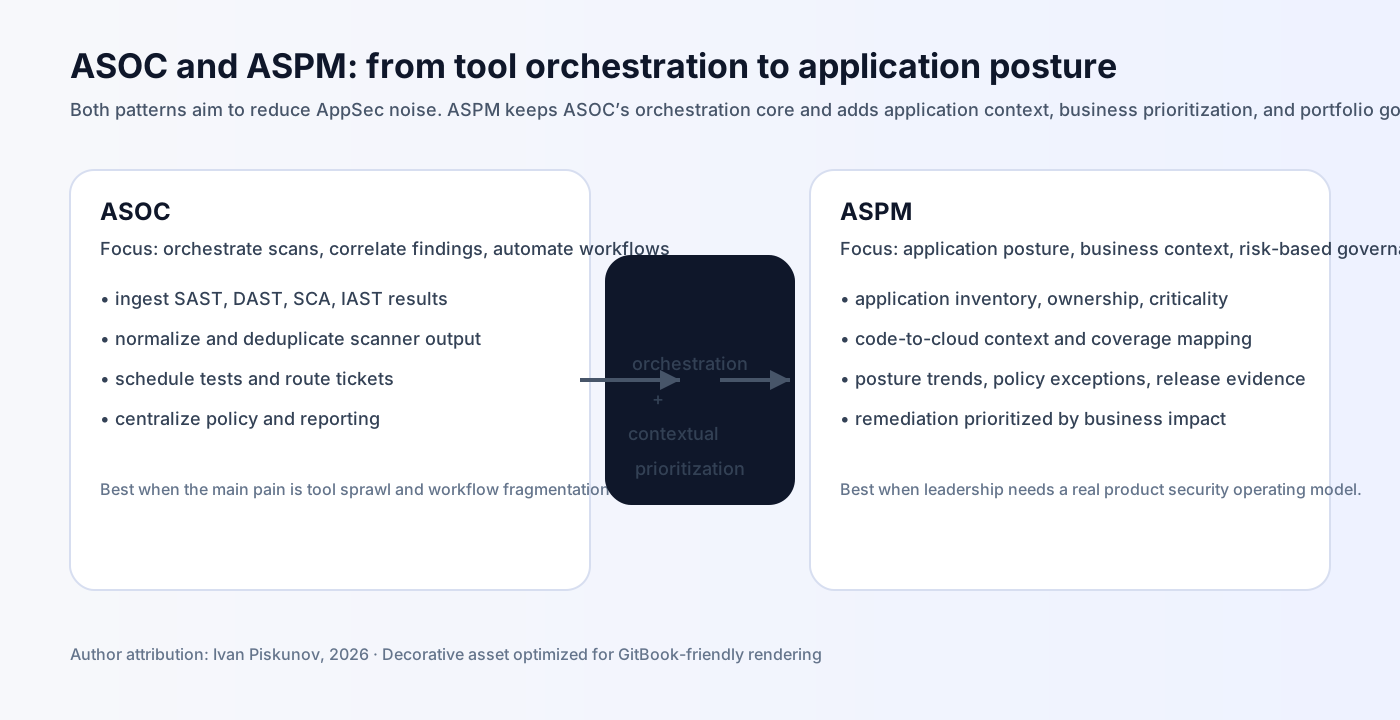
Intro: Teams usually discover this class of platforms after they accumulate too many AppSec tools, too many dashboards, and too many unowned findings. The question stops being “which scanner should we add?” and becomes “how do we turn scanner output into a governable product security operating model?”
What this page includes
- what ASOC and ASPM mean in practice
- where they overlap and where they differ
- a vendor-oriented market map with careful Gartner context
- a vendor-neutral deployment model
- installation and configuration patterns
- sample integration snippets for SAST, DAST, SCA, secrets, and container scanning
Working assumptions
- your organization already runs multiple AppSec signals such as SAST, DAST, SCA, secrets, container, IaC, API, or CI/CD checks
- you want a platform that improves prioritization, ownership, and release decisions rather than adding yet another isolated scanner
Why this class of platform exists
A modern product organization might run some combination of:
- SAST for first-party code
- SCA for open source dependencies
- secrets detection for repositories and CI logs
- container and image scanning
- DAST for running applications and APIs
- IaC scanning for Terraform, Kubernetes, and cloud templates
- policy gates in CI/CD
- ticketing, sprint, and release evidence systems
Each tool is useful on its own, but together they create several structural problems:
- duplicate findings across tools;
- missing ownership because the scanner knows the repo but not the accountable product team;
- weak prioritization because severity alone does not equal business risk;
- tool sprawl and too much context switching;
- poor evidence collection for audits, customers, and release governance;
- difficulty measuring program health at a director level.
That is the gap ASOC tried to solve first, and that ASPM now addresses in a broader, more product-centric way.
1) What ASOC is
ASOC stands for Application Security Orchestration and Correlation.
In practical terms, ASOC is the operational layer that sits above multiple AppSec tools and helps you:
- orchestrate when scans happen;
- ingest results from multiple tools;
- normalize formats;
- deduplicate and correlate overlapping findings;
- push work into issue trackers and remediation queues;
- apply policies consistently across projects and teams.
Think of ASOC as AppSec control-plane automation. It is close in spirit to “SOAR for application security,” but with a stronger focus on build pipelines, test scheduling, result normalization, and remediation workflows.
Where ASOC is strongest
ASOC tends to be strong when you need:
- a single intake and workflow layer across many scanners;
- centralized policy enforcement for scan scheduling and ticket routing;
- consistent reporting across heterogeneous tools;
- a transition step from ad hoc AppSec to managed AppSec operations.
Where ASOC starts to feel insufficient
Traditional ASOC implementations often struggle when the real question becomes:
Which application matters most to the business right now, which risk is genuinely exploitable, and which team should fix it first without slowing delivery?
That is where ASPM usually becomes the better framing.
2) What ASPM is
ASPM stands for Application Security Posture Management.
ASPM absorbs many of the useful mechanics of ASOC—aggregation, normalization, orchestration, deduplication—but extends them with a broader, more executive-useful model:
- application inventory and ownership mapping;
- business-context prioritization;
- code-to-cloud visibility;
- policy and posture tracking across SDLC stages;
- trend analysis and executive reporting;
- remediation workflows tied to product teams and release processes;
- broader support for supply chain, cloud, API, and runtime-adjacent context.
In other words:
- ASOC is mostly about workflow and result orchestration.
- ASPM is about risk posture, governance, and prioritization at scale.
What ASPM usually adds beyond ASOC
A mature ASPM program typically adds:
- application-centric views instead of only tool-centric dashboards;
- risk scoring with business context, not just CVSS or scanner severity;
- owner-aware routing so findings land with the correct team;
- portfolio-level posture for product lines, business units, and critical apps;
- control coverage visibility so leaders can see what is not being scanned;
- evidence and compliance mapping for secure SDLC attestations and audits.
3) ASOC vs ASPM in one table
| Dimension | ASOC | ASPM |
|---|---|---|
| Primary focus | Scan orchestration, result correlation, workflow automation | Application posture, risk prioritization, program governance |
| Core unit of analysis | Findings and tool outputs | Applications, services, owners, risk posture |
| Typical problem solved | “How do I unify scanner output and workflows?” | “How do I understand and improve software risk at scale?” |
| Business context | Limited or bolt-on | Usually first-class |
| Developer routing | Often supported, but secondary | Usually built into prioritization and ownership |
| Inventory and coverage mapping | Partial | Stronger and more portfolio-oriented |
| Executive reporting | Basic to moderate | Stronger, posture and trend oriented |
| Release governance use | Possible, usually custom | Strong fit when tied to policy and gate evidence |
| Tool replacement strategy | Usually integrates existing scanners | May integrate existing scanners and/or add native capabilities |
| Best fit | Teams overwhelmed by tool sprawl and workflow fragmentation | Teams that need risk-based leadership, coverage insight, and scalable governance |
4) Market note: how to read the vendor landscape
A careful Gartner-oriented note
Publicly accessible Gartner pages are much easier to verify for ASPM than for ASOC at the moment. I could verify:
- Gartner research discussing posture tooling for AppSec;
- current Gartner Peer Insights market pages for Application Security Posture Management (ASPM) Tools.
I could not verify a current public Gartner market page dedicated to ASOC with the same confidence. Because of that, the ASPM shortlist below is tied to public Gartner-accessible market signals, while the ASOC examples are presented as legacy or adjacent reference points, not as a definitive live Gartner ranking.
That distinction matters, especially if you plan to reuse this page for vendor shortlisting or budget discussions.
5) Top 4 current ASPM examples to track
Based on the publicly accessible Gartner market footprint for Application Security Posture Management (ASPM) Tools, these are strong examples to know:
| Vendor | Product | Why it matters |
|---|---|---|
| ArmorCode | ArmorCode Platform | Strong unification, correlation, and broad exposure visibility across apps, cloud, and supply chain |
| Cycode | Cycode ASPM Platform | Code-to-cloud posture with strong software factory and supply-chain angle |
| Checkmarx | Checkmarx ASPM / Checkmarx One | Strong fit if you want ASPM tied tightly to a broad AppSec testing platform |
| Apiiro | Apiiro ASPM Platform | Deep code context, code-to-runtime mapping, and app inventory/risk graph style workflows |
How to think about these four
- ArmorCode fits well when you want a cross-domain exposure and workflow layer that spans more than classic AppSec.
- Cycode often appeals to organizations that want security visibility across SCM, CI/CD, and software supply chain operations.
- Checkmarx is compelling when the organization already leans into a single AppSec platform strategy.
- Apiiro is strong when application context, ownership, code lineage, and risk graph style correlation are central concerns.
Selection tip: do not pick only on “number of integrations.” The stronger buying question is whether the platform can map findings to a stable application model, business owner, release process, and remediation lane.
6) ASOC reference products to know
Because ASOC is best treated as a legacy or overlapping term, use the list below as a reference map, not a hard “top right quadrant” claim.
| Vendor | Product | Why it belongs in the conversation |
|---|---|---|
| Black Duck | Software Risk Manager (with Code Dx heritage) | A classic illustration of ASOC-style correlation, deduplication, policy, and centralized reporting |
| OpenText | Application Security Platform / ASPM | Shows the evolution from scanner suite + orchestration into a broader unified platform |
| Checkmarx | Checkmarx One | Useful as a modern platform where orchestration is embedded inside broader AppSec posture and testing workflows |
| Veracode | Veracode Platform | Represents the mature “single pane + policy + remediation workflow” operating model even if buyers may classify it under broader AppSec rather than pure ASOC |
Takeaway
If you are buying today, think in ASPM terms.
If you are describing the workflow DNA underneath many of these platforms, ASOC is still a useful concept.
7) What these platforms give to a project, team, and company
For a project
- one place to see the current security posture of the application;
- fewer duplicate tickets and less argument about which scanner is “right”;
- cleaner release readiness checks;
- better evidence for customer due diligence and audits;
- more predictable remediation queues.
For a product or engineering team
- clearer ownership of findings;
- less time lost in dashboard hopping;
- actionable priorities rather than raw vulnerability dumps;
- security work aligned with sprint planning and release trains;
- reduced friction between AppSec and delivery teams.
For a company
- better portfolio-level visibility across business-critical applications;
- stronger board- and leadership-level reporting;
- improved audit readiness and evidence retention;
- faster identification of control gaps;
- more consistent enforcement of secure SDLC expectations across teams.
8) Vendor-neutral architecture pattern
Below is a general reference architecture that works for most ASOC/ASPM-style platforms.
                   +-------------------------------+
                   |      Identity / SSO / RBAC    |
                   +-------------------------------+
                                  |
                                  v
+-------------+     +---------------------------+     +----------------------+
| SCM / CI/CD | --> | Ingestion + Connector Bus | --> | Normalization Engine |
+-------------+     +---------------------------+     +----------------------+
       |                          |                               |
       |                          v                               v
       |                 +----------------+              +--------------------+
       |                 | Raw Finding DB |              | Correlation Engine |
       |                 +----------------+              +--------------------+
       |                                                           |
       v                                                           v
+-------------+                                            +-------------------+
| SAST / DAST | -----------------------------------------> | Risk / Policy     |
| SCA / IaC   |                                            | Engine            |
| Secrets     |                                            +-------------------+
| Containers  |                                                     |
+-------------+                                                     v
                                                            +-------------------+
                                                            | Workflow / Tickets |
                                                            | Slack / Email      |
                                                            +-------------------+
                                                                     |
                                                                     v
                                                            +-------------------+
                                                            | Dashboards / KPIs |
                                                            | Evidence / Audit  |
                                                            +-------------------+
Recommended logical layers
Ingestion layer
Connectors, APIs, webhooks, report upload, CI artifact readers.Normalization layer
Converts scanner-specific formats into a common internal schema.Correlation layer
Deduplicates and links findings across repos, components, images, APIs, and environments.Application model
Maps findings to applications, services, repos, owners, criticality tiers, and business domains.Risk and policy engine
Applies rules such as release blocking, escalation, SLA, exception handling, and evidence requirements.Workflow layer
Creates tickets, routes remediation, notifies teams, and tracks exceptions.Reporting and evidence layer
Dashboards, exports, posture trends, compliance mappings, and release evidence.
9) Vendor-neutral installation patterns
You asked for an installation and configuration view without tying this to one vendor, so below is a generalized model.
Pattern A — Small-to-medium team, single-region deployment
Use when:
- you want fast onboarding;
- the platform is primarily serving AppSec and product security;
- data residency is simple.
Core components
- web/API service;
- worker service for imports, parsing, and enrichment;
- relational database;
- cache or queue;
- object storage for imported reports and evidence;
- ingress with SSO.
Example docker-compose.yml
version: "3.9"

services:
  postgres:
    image: postgres:16
    environment:
      POSTGRES_DB: appsec_platform
      POSTGRES_USER: appsec
      POSTGRES_PASSWORD: change-me
    volumes:
      - pgdata:/var/lib/postgresql/data

  redis:
    image: redis:7

  api:
    image: registry.example.com/aspm/api:latest
    environment:
      DATABASE_URL: postgresql://appsec:change-me@postgres:5432/appsec_platform
      REDIS_URL: redis://redis:6379/0
      STORAGE_BUCKET: appsec-evidence
      OIDC_ISSUER: https://sso.example.com
      OIDC_CLIENT_ID: aspm-platform
      OIDC_CLIENT_SECRET: change-me
    ports:
      - "8080:8080"
    depends_on:
      - postgres
      - redis

  worker:
    image: registry.example.com/aspm/worker:latest
    environment:
      DATABASE_URL: postgresql://appsec:change-me@postgres:5432/appsec_platform
      REDIS_URL: redis://redis:6379/0
      STORAGE_BUCKET: appsec-evidence
    depends_on:
      - postgres
      - redis

  webhook:
    image: registry.example.com/aspm/webhook:latest
    environment:
      API_BASE_URL: http://api:8080
      SHARED_SECRET: replace-with-long-random-value
    depends_on:
      - api

volumes:
  pgdata:
Pattern B — Enterprise Kubernetes deployment
Use when:
- you need HA and autoscaling;
- imports and enrichment are heavy;
- multiple business units feed the platform;
- connectors and workers need isolated execution.
Example values.yaml
global:
  imageRegistry: registry.example.com
  storageClass: gp3
  oidc:
    issuer: https://sso.example.com
    clientId: aspm-platform
    clientSecretRef: aspm-oidc-secret

api:
  replicaCount: 3
  resources:
    requests:
      cpu: "500m"
      memory: "1Gi"
    limits:
      cpu: "2"
      memory: "4Gi"

workers:
  replicaCount: 4
  queueNames:
    - ingest
    - correlate
    - enrich
    - notifications
  resources:
    requests:
      cpu: "500m"
      memory: "1Gi"
    limits:
      cpu: "4"
      memory: "8Gi"

postgresql:
  enabled: false

externalDatabase:
  host: postgres-rw.database.svc.cluster.local
  port: 5432
  database: appsec_platform
  username: appsec
  passwordSecretRef: appsec-db-secret

redis:
  enabled: true

ingress:
  enabled: true
  className: nginx
  hosts:
    - host: aspm.example.com
      paths:
        - path: /
          pathType: Prefix
  tls:
    - secretName: aspm-tls
      hosts:
        - aspm.example.com
Hardening recommendations
- enforce SSO with MFA through OIDC or SAML;
- create RBAC roles for admin, platform engineer, AppSec analyst, product security lead, and read-only executive viewers;
- isolate connector secrets in a vault, not in plain env files;
- use separate service accounts or tokens per integration;
- enable audit logging for policy changes and exceptions;
- encrypt report storage and database backups;
- define a data retention policy for raw findings, evidence, and tickets.
10) A good initial data model
A platform in this class becomes useful only after you model the estate properly.
Minimal entities to create on day one
| Entity | Purpose |
|---|---|
| Business unit | executive grouping |
| Product | ties applications to business outcomes |
| Application / service | primary risk object |
| Repository | scanner and ownership anchor |
| Environment | dev, test, staging, prod |
| Criticality tier | used for prioritization and SLA |
| Owner | accountable engineering or product team |
| Finding | normalized risk item |
| Exception | approved risk acceptance record |
| Release / version | evidence and gating anchor |
Sample bootstrap catalog
business_units:
  - id: BU-PAYMENTS
    name: Payments
  - id: BU-CORE
    name: Core Platform

products:
  - id: PROD-CHECKOUT
    name: Checkout
    business_unit: BU-PAYMENTS

applications:
  - id: APP-CHECKOUT-API
    name: checkout-api
    product: PROD-CHECKOUT
    criticality: tier-1
    internet_exposed: true
    pii: true
    owner_team: team-checkout

repositories:
  - id: REPO-CHECKOUT-API
    url: git@git.example.com:payments/checkout-api.git
    application: APP-CHECKOUT-API
    default_branch: main
11) Integration patterns by signal type
SAST
Typical input: SARIF, JSON, XML, native platform APIs.
Good practice
- preserve scanner-native severity and confidence;
- also compute an internal normalized severity;
- keep fingerprinting stable across branches and reimports;
- map result to repo, path, rule ID, and owning team.
Example SAST connector config
connectors:
  - name: semgrep-main
    type: sast
    parser: sarif
    source: s3://security-artifacts/semgrep/
    schedule: "*/15 * * * *"
    app_mapping:
      from_repo_path: true
    metadata:
      tool_name: semgrep
      environment: ci
DAST
Typical input: HTML, XML, JSON, native API exports.
Good practice
- record target URL and environment;
- distinguish authenticated scans from anonymous scans;
- keep evidence such as request, response, screenshot, and proof if supported;
- tie the scan to a release candidate or deployment build when possible.
Example ZAP upload contract
dast_scans:
  - tool: zap
    target: https://staging.example.com
    app_id: APP-CHECKOUT-API
    release: 2026.03.27-rc1
    report_path: artifacts/zap-report.json
    scan_profile: baseline-authenticated
SCA
Typical input: JSON, SBOM, CycloneDX, SPDX, tool-specific exports.
Good practice
- preserve package URL (purl) when available;
- record direct vs transitive dependency;
- keep fix version and exploit maturity if the source provides it;
- deduplicate by package + version + application context.
Example SCA import shape
{
  "tool": "dependency-check",
  "application": "APP-CHECKOUT-API",
  "release": "2026.03.27-rc1",
  "artifact_type": "cyclonedx",
  "artifact_path": "artifacts/bom.json",
  "labels": {
    "language": "java",
    "build_system": "gradle"
  }
}
Secrets detection
Typical input: SARIF, JSON, text exports.
Good practice
- do not store raw secrets in dashboards if avoidable;
- hash or partially mask values;
- separate revoked vs still active secret incidents;
- track whether rotation was confirmed.
Example secret event model
secrets_findings:
  - app: APP-CHECKOUT-API
    repo: REPO-CHECKOUT-API
    detector: gitleaks
    secret_type: aws_access_key
    status: active
    first_seen_commit: a1b2c3d4
    masked_value: AKIA****9X2P
    rotation_ticket: SEC-4821
Container / image vulnerability scanning
Typical input: JSON, CycloneDX, SARIF, vendor-specific API responses.
Good practice
- store image digest, not only tags;
- separate base image findings from app layer findings if the scanner allows it;
- keep deployment context: “built” is different from “deployed to prod”;
- correlate image findings back to service, repo, and environment.
Example image scan import
images:
  - image: registry.example.com/payments/checkout-api
    digest: sha256:0f12d0d7deadbeef
    tag: "2026.03.27-rc1"
    deployed_to:
      - staging
      - prod
    scanner: trivy
    report: artifacts/trivy-image.json
    application: APP-CHECKOUT-API
12) A policy model that actually scales
Do not start with dozens of policies. Start with a few policies that are:
- understandable by engineers;
- measurable by the platform;
- tied to release decisions or SLA;
- flexible enough to allow exceptions with accountability.
Example policy pack
policies:
  - id: rel-block-critical-prod
    description: block production release when an internet-facing tier-1 app has an unresolved critical finding with exploit evidence
    applies_to:
      criticality: [tier-1]
      internet_exposed: true
      environment: [prod]
    conditions:
      severity: [critical]
      exploitability: [confirmed, strong-indicators]
      status: [open, reopened]
    action: block_release

  - id: require-secret-rotation
    description: require rotation workflow for active leaked cloud credentials
    applies_to:
      secret_type: [aws_access_key, github_pat]
      status: [active]
    action: create_p1_ticket

  - id: require-sbom-for-release
    description: release candidate must include an SBOM artifact
    applies_to:
      environment: [staging, prod]
    conditions:
      sbom_present: false
    action: fail_pipeline
13) Rollout plan that does not fail
Phase 1 — Inventory and mapping first
Do not begin with hard blocking. Start by answering:
- what are our applications?
- who owns them?
- which repos and images belong to them?
- which tools feed reliable signals today?
Phase 2 — Normalize and deduplicate
Focus on:
- stable application model;
- consistent connector quality;
- duplicated findings cleanup;
- initial dashboards and weekly triage.
Phase 3 — Introduce risk-based policies
Examples:
- release evidence required for tier-1 apps;
- block on confirmed criticals for internet-facing prod services;
- SLA for active leaked credentials;
- missing owner is a policy violation.
Phase 4 — Executive and audit reporting
Add:
- coverage dashboards;
- backlog and aging metrics;
- exception trends;
- release gate trend line;
- evidence exports for customer due diligence.
14) Common failure modes
Buying posture software before building ownership mapping
The platform becomes a prettier alert bucket.Letting every scanner keep its own severity scale without normalization
Leadership reporting becomes unreliable.Trying to block releases too early
Teams will route around the platform.Storing only repo-level metadata
You lose product, business, and release context.Failing to model exceptions
Teams work around policy outside the platform.No evidence strategy
Audit and customer questionnaires remain manual and painful.
15) When to choose ASOC-first vs ASPM-first
Choose an ASOC-first operating model when
- tooling is fragmented and unmanaged;
- the immediate problem is scanner sprawl and workflow chaos;
- your AppSec team needs centralized intake, routing, and reporting first.
Choose an ASPM-first operating model when
- you already have multiple AppSec feeds and need better prioritization;
- leadership wants portfolio posture, evidence, and trend reporting;
- you need stronger mapping from code to application to business context;
- product security is expected to report against business risk, not just vulnerability counts.
16) Practical selection checklist
Use this checklist during evaluation.
Application model
- Can the platform model products, applications, services, repos, images, and environments cleanly?
- Can you assign owners and business criticality without ugly workarounds?
Connectors
- How many native integrations matter to your stack, not just on the marketing slide?
- How stable are reimports and deduplication?
Policy
- Can you define blocking rules, SLAs, exceptions, and evidence requirements in a maintainable way?
- Can policies differ by criticality tier or environment?
Workflow
- Can the platform create tickets intelligently and avoid duplicates?
- Does it support feedback loops from developers and release managers?
Executive reporting
- Can it show coverage gaps, aging backlog, exception debt, and release blocking trends?
- Can it export evidence for audits and customer reviews?
Data portability
- Can you export findings, evidence, and mappings cleanly?
- Is the object model understandable or opaque?
17) Cross-links
- For the broader platform and triage context, see 🥋 DefectDojo and ASPM Platforms.
- For release blocking and gate logic, see Security Quality Gates and Release Blocking.
- For GitLab-centric orchestration, see Gate Aggregation Scripts.
- For ownership and leadership metrics, see 📈 Product Security Director Metrics.
References and market notes
Use this page as a practical operating guide, not as a substitute for a formal analyst licensing process.
Publicly accessible sources used to shape this page include:
- Gartner research on posture tooling for AppSec
- Gartner Peer Insights market pages for ASPM tools
- vendor documentation and market pages from Checkmarx, Apiiro, ArmorCode, Black Duck, and OpenText
Footer note: Elegant, GitBook-friendly knowledge base content works best when diagrams, snippets, and policy examples reinforce a stable operating model. Treat this page as a control-plane guide, not as a product brochure.