API Security
Section focus: API Security.
Best use: start with the section map below, then move into the deeper pages that match your role or stack.
Design note: this index was refreshed to act as a cleaner GitBook landing page instead of a plain directory listing.
Start with these pages
| Page | Why open it first |
|---|---|
| API Design and Contract Security | High-value page inside API Security. |
| API Authentication and Authorization | High-value page inside API Security. |
| API Abuse Resilience and Rate Limits | High-value page inside API Security. |
| 🧭 API Authorization, Business-Flow Abuse, and Third-Party API Consumption | High-value page inside API Security. |
| API Testing, Observability, and Release Gates | High-value page inside API Security. |
| 🕸️ GraphQL Security Review and Abuse Patterns | High-value page inside API Security. |
| 🛰️ GraphQL and gRPC Security Review Patterns | Focused reviewer page for GraphQL depth/complexity limits and gRPC auth, deadlines, and streaming controls. |
| API Gateway Policy Examples | High-value page inside API Security. |
| 🔐 API Security in Action — Modern Patterns and Review Questions | High-value page inside API Security. |
Related sections
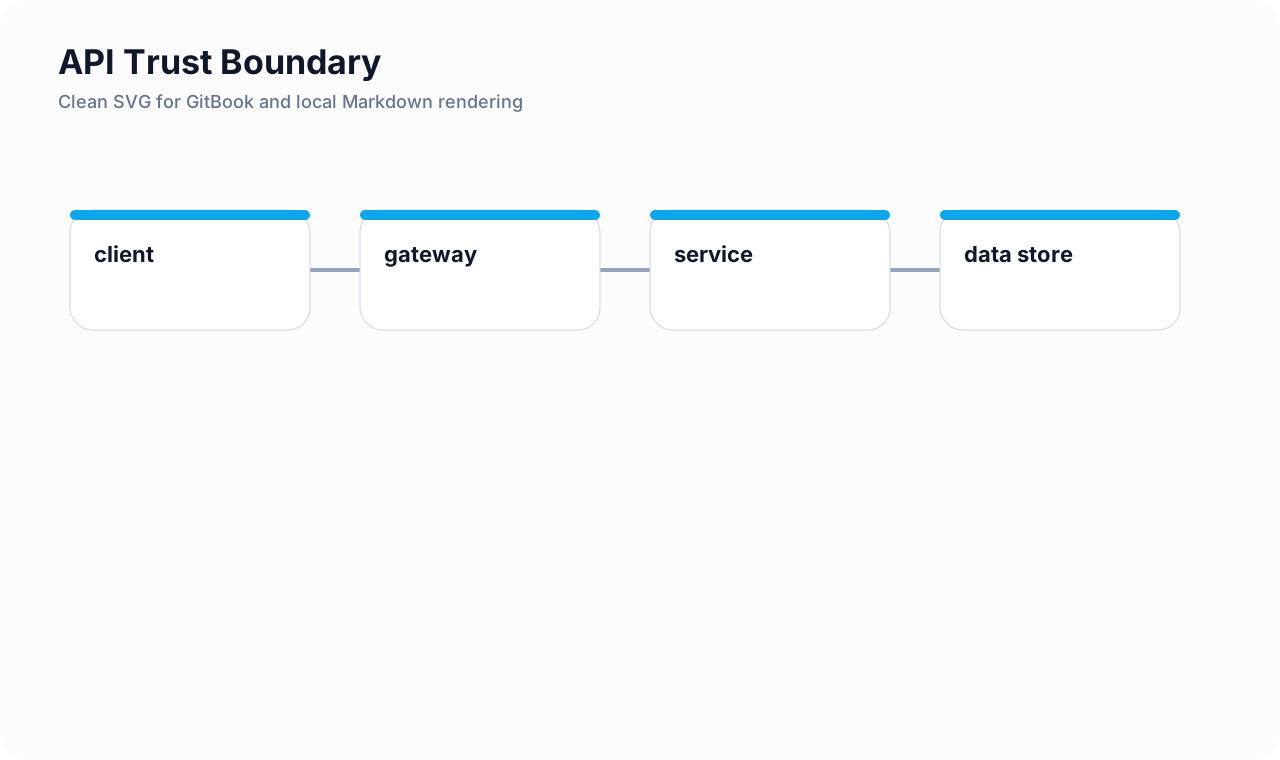
Intro: API security sits at the intersection of architecture, identity, validation, and abuse resistance. This section turns that broad idea into pages that support design review, implementation hardening, and release decisions.
What this page includes
- the main trust boundaries around APIs
- what to review in contracts, authorization, abuse control, and release gates
- how API controls connect to cloud and CI/CD systems
Working assumptions
- APIs are often both a product surface and an internal integration surface, so mistakes scale quickly
Section map
| Page | Why it belongs here |
|---|---|
| API Design and Contract Security | This page treats the contract as a security-bearing artifact and defines what belongs in the specification before code hardens unsafe assumptions. |
| API Authentication and Authorization | This page separates caller identity, function-level access, and object or property-level authorization. |
| API Abuse Resilience and Rate Limits | This page covers budget control, business-flow abuse, and request shaping as security controls. |
| API Authorization, Business-Flow Abuse, and Third-Party API Consumption | Consolidates object authorization, workflow invariants, and upstream trust into one reviewer lens. |
| API Testing, Observability, and Release Gates | This page connects design assumptions to negative testing, telemetry, and release review. |
| GraphQL Security Review and Abuse Patterns | Covers schema discoverability, resolver authorization, and malicious-operation controls that path-based API reviews miss. |
| GraphQL and gRPC Security Review Patterns | Adds API-style review guidance for GraphQL complexity control and gRPC transport, identity, and stream handling. |
API security belongs early in design, not only in testing. The source material correctly treats the API definition itself as a security control: if the contract is weak, the implementation inherits weak assumptions.
Core principle
Treat the API specification as:
- a product interface;
- a security contract;
- a testing input;
- a deployment artifact that should remain version-controlled.
Review lens
Before release, ask:
- Is the API spec current and reviewed?
- Are authentication and authorization explicit for every sensitive route?
- Can another tenant's object be reached by changing identifiers or workflow state?
- Are telemetry and abuse signals useful to operations and product owners?
Related pages
- API Design and Contract Security
- API Authentication and Authorization
- API Abuse Resilience and Rate Limits
- API Authorization, Business-Flow Abuse, and Third-Party API Consumption
- API Testing, Observability, and Release Gates
- GraphQL Security Review and Abuse Patterns
- Threat Modeling
- Application Security
Suggested reference links
Author attribution: Ivan Piskunov, 2026 - Educational and defensive-engineering use.