⚔️ Hands-On Attack-to-Defense Playbooks for Product Security
Intro: Reading attack patterns is useful, but engineering judgment gets stronger when the same scenario is viewed as an attack path, a detection problem, a containment problem, and a hardening problem. These playbooks are designed to help AppSec, DevSecOps, cloud, and Kubernetes engineers practice that full loop.
How to use this page: pick one scenario, reproduce it safely in a lab, collect the evidence you would expect in a real environment, and finish only when you can explain both the fix and the proof that the fix works.
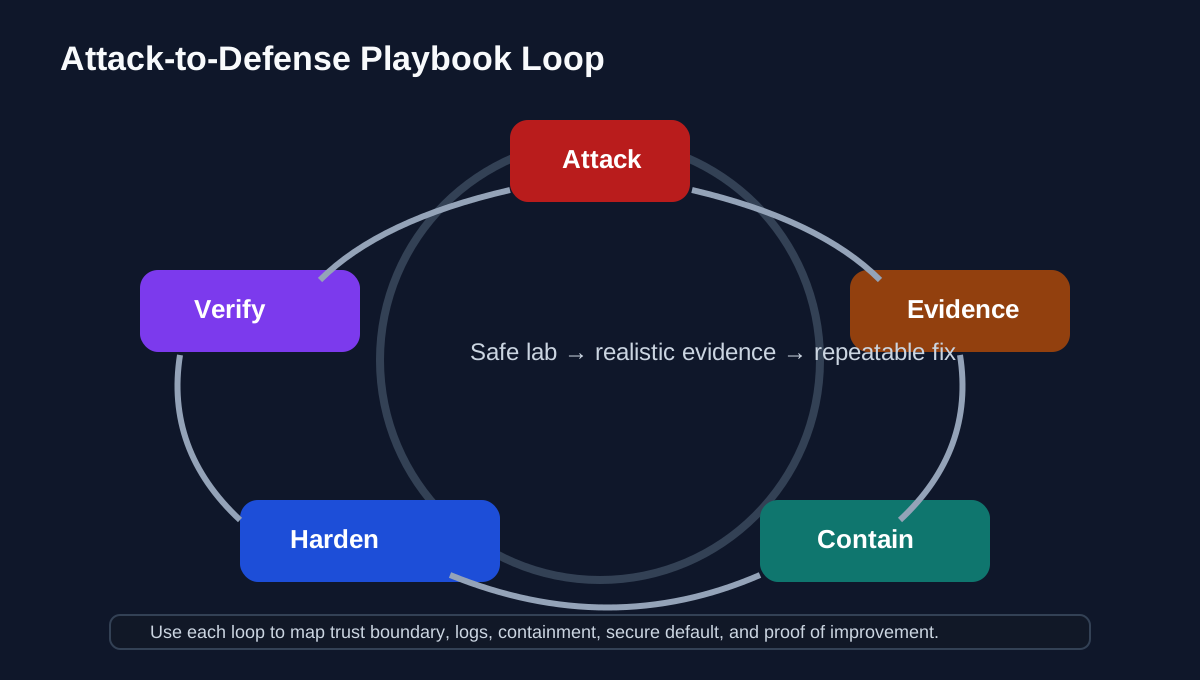
What a good hands-on playbook contains
Each playbook should answer six questions:
- What is the attacker trying to achieve?
- Which trust edge is being crossed?
- What evidence would we see in code, config, logs, and cloud control planes?
- How do we contain the issue without creating more damage?
- What secure default or control pattern prevents recurrence?
- How do we verify the environment is truly better, not just quieter?
Suggested playbook sequence
| Playbook | Best role fit | Primary skill you build |
|---|---|---|
| Broken API authorization and tenant-boundary abuse | AppSec, backend security | abuse thinking, authorization review, test design |
| SSRF to metadata or internal-control-plane abuse | AppSec, cloud security | trust-boundary reasoning, egress control, identity isolation |
| CI token theft and pipeline-to-repository compromise | DevSecOps, platform security | runner trust, secret handling, blast-radius reduction |
| Kubernetes workload-to-cluster escalation | Kubernetes, cloud-native security | pod security, workload identity, containment |
| IAM / IaC privilege drift and cloud escalation | cloud security, DevSecOps | policy review, blast-radius analysis, detective guardrails |
| Dependency or build-provenance compromise | supply-chain security | artifact trust, attestations, rollback discipline |
Playbook 1 — Broken API authorization and tenant-boundary abuse
Attack path
A user can read or modify another tenant's object because the service validates authentication but not object-level authorization. The attacker iterates IDs, abuses predictable references, or pivots through an admin/helper endpoint.
Practice safely
- Use a lab like Juice Shop or a deliberately vulnerable internal demo app.
- Create two users from different tenants.
- Capture the exact request and response differences when the wrong tenant's object is fetched or mutated.
- Add a regression test that fails before the fix and passes after the fix.
Evidence to collect
- access logs showing subject, object, route, and decision outcome;
- application logs for authN success without matching authZ checks;
- unit/integration tests that prove cross-tenant access was previously allowed;
- design docs or route definitions that show the object-owner check was implicit instead of explicit.
Defensive response
- enforce object-level authorization in the service layer, not only in the UI or gateway;
- make tenant context explicit in request handling and storage access;
- log denied and allowed sensitive object actions with consistent identifiers;
- add pre-release abuse tests for horizontal and vertical authorization.
“Done” looks like
- the same abuse request is denied consistently across UI, API, and background jobs;
- logs now show why the action was denied;
- automated tests prevent the bug from returning;
- reviewers can point to the exact policy or code path enforcing ownership.
Best cross-links:
- API Authorization, Business Flows, and Third-Party API Consumption
- Business Logic Vulnerabilities and Verification
- Worked Example — API Review Lab
Playbook 2 — SSRF to metadata or internal-control-plane abuse
Attack path
A file-fetcher, webhook validator, PDF renderer, avatar importer, or URL-preview feature allows server-side requests to attacker-controlled destinations. The attacker then targets metadata services, private admin interfaces, or internal APIs.
Practice safely
- Use a local SSRF-safe lab or a non-production sandbox.
- Reproduce the issue against a harmless local endpoint first.
- Test whether the component can reach link-local or RFC1918 ranges, internal DNS names, or cloud metadata addresses.
- Record what identity or credential would be exposed if the same pattern existed in production.
Evidence to collect
- app logs for outbound fetch destinations;
- proxy, egress, or VPC flow logs;
- cloud audit logs if metadata-derived credentials are later used;
- code paths that accept URL input without scheme/host allow-listing.
Defensive response
- deny metadata-service and private-range access unless explicitly required;
- put outbound proxy or egress filtering in front of fetcher-style components;
- use workload identity instead of static credentials, and scope it narrowly;
- normalize URL parsing and reject dangerous schemes or redirect chains.
“Done” looks like
- the component can only call approved destinations;
- metadata access is blocked or meaningless because the attached identity is tightly scoped;
- detections exist for suspicious outbound fetch patterns;
- tests cover redirect, DNS rebinding, and internal-address edge cases.
Best cross-links:
- SSRF, File Fetch, and Parser Abuse
- Zero-Trust Egress and Private Connectivity Patterns
- Cloud Attack Chains
Playbook 3 — CI token theft and pipeline-to-repository compromise
Attack path
A pipeline leaks a long-lived token, over-privileged runner identity, or repository secret. The attacker modifies workflows, publishes malicious artifacts, accesses packages, or uses CI as a stepping stone into cloud resources.
Practice safely
- Use a disposable training repo or pipeline sandbox.
- Inventory every secret, token, and cloud identity reachable from the runner.
- Simulate exfiltration by proving which actions the token could take, without actually performing harmful changes.
- Compare behavior between ephemeral and persistent runners.
Evidence to collect
- pipeline logs and job definitions;
- runner configuration and network placement;
- audit trails for repo, package, registry, and cloud actions;
- evidence of branch protection, CODEOWNERS, approval gates, and environment protections.
Defensive response
- replace broad static secrets with short-lived federation where possible;
- isolate runners by trust tier and keep privileged jobs off shared runners;
- lock down workflow modification paths and deployment approvals;
- generate provenance, attestations, and release evidence for high-trust builds.
“Done” looks like
- token blast radius is small and easy to explain;
- runner compromise does not automatically imply repo-admin or cloud-admin access;
- critical workflow changes require controlled review;
- artifact trust can be traced through provenance and release evidence.
Best cross-links:
- Runner Isolation and Trust Boundaries
- GitHub Actions for Product Security
- GitLab CI/CD Modern Security Patterns
- Signing, Attestation, and Verification — Legacy vs Current
Playbook 4 — Kubernetes workload-to-cluster escalation
Attack path
A container starts with unsafe privileges, a mounted service account token, weak admission controls, or excessive namespace permissions. The attacker gets code execution in the pod, then attempts credential theft, secret access, lateral movement, or cluster-control-plane actions.
Practice safely
- Use Kubernetes Goat, EKS Goat, or a disposable sandbox cluster.
- Start from a workload with one intentionally weak control at a time: privileged mode, hostPath, broad RBAC, or unrestricted egress.
- Record which escalation steps are blocked and which remain possible.
- Compare namespace policy labels and admission decisions before and after hardening.
Evidence to collect
- Kubernetes audit logs and admission decisions;
- workload YAML, RBAC bindings, and service-account references;
- runtime detections from Falco, Tetragon, or cloud-native signals;
- cloud audit logs if the workload federates into provider IAM.
Defensive response
- apply Pod Security Standards or equivalent admission policy;
- minimize service-account privileges and avoid token mounting where unnecessary;
- enforce network policy, image provenance, and runtime signal collection;
- make namespace trust tiers explicit instead of letting everything behave the same.
“Done” looks like
- the workload no longer escalates through the same route;
- the namespace has an explicit security posture;
- RBAC and workload identity are easy to explain;
- runtime detections are validated against a safe simulation.
Best cross-links:
- Kubernetes Attack Chains
- Kubernetes Hardening
- Kubernetes API Access Hardening
- Cloud and Kubernetes Runtime Investigation Playbooks
Playbook 5 — IAM / IaC privilege drift and cloud escalation
Attack path
A small Terraform, ARM/Bicep, or CloudFormation change introduces broader trust than intended: wildcard actions, public exposure, cross-account role assumption, or logging gaps. The attacker chains those misconfigurations into privilege escalation or stealth.
Practice safely
- Use Terragoat, CloudGoat, or a disposable sandbox account/subscription/project.
- Review the delta at both the IaC layer and the deployed-resource layer.
- Map which principals, networks, and data stores are newly exposed.
- Verify whether the same issue would be caught by review, policy-as-code, and detective controls.
Evidence to collect
- pull request diff and plan/apply output;
- cloud IAM policy simulator results or equivalent reasoning;
- posture findings and audit logs;
- explicit list of resources whose blast radius changed.
Defensive response
- require least-privilege review for non-human identities and trust policies;
- codify guardrails with policy-as-code and preventive controls;
- maintain immutable logging for privilege and trust-path changes;
- review public exposure and transitive trust, not only resource-local settings.
“Done” looks like
- the risky change is blocked before apply or flagged immediately after;
- reviewers can name the principal, trust edge, and resource blast radius;
- logging exists for the risky control-plane actions;
- the secure pattern is captured as a reusable baseline.
Best cross-links:
- Cloud Attack Chains
- AWS IAM and Role Design
- IaC and Policy as Code
- Terraform Security Scanning and Checkov
Playbook 6 — Dependency or provenance compromise
Attack path
A malicious dependency update, build-script modification, compromised maintainer path, or unsigned artifact enters the pipeline. The attacker aims to get untrusted code built, published, or deployed under the cover of normal automation.
Practice safely
- use a training repository or dependency-management demo project;
- compare a normal update flow with one that changes trust assumptions: maintainer, source, lockfile, or build step;
- verify whether provenance, attestation, and policy checks would detect the difference;
- test the rollback path, not only the prevention path.
Evidence to collect
- dependency PR history and review approvals;
- SBOM, provenance, or attestation artifacts;
- package-manager lockfile changes and source redirects;
- release evidence linking commit, build, artifact, and deploy decision.
Defensive response
- protect workflow files, release paths, and package publication identities;
- use automated dependency updates with policy and test controls;
- generate provenance and verify it before promotion;
- keep rollback and revocation playbooks ready for suspect releases.
“Done” looks like
- high-trust releases can be traced back to reviewed source and controlled builds;
- suspicious dependency or workflow changes are visible quickly;
- deployment promotion depends on trust evidence, not only build success;
- rollback is rehearsed and not invented during the incident.
Best cross-links:
- Software Supply Chain Foundations
- GitLab Release Evidence
- Chainloop and Supply-Chain Evidence
- OpenSSF Scorecard and Dependency Trust Signals
A simple scoring model for practice
Use a 0–2 score for each area after you finish a playbook:
- Exploit understanding — can you explain the attacker’s path without hand-waving?
- Evidence mapping — can you name the logs, configs, and artifacts that prove it happened?
- Containment quality — can you reduce damage before the full fix lands?
- Prevention quality — did you implement a reusable control rather than a one-off patch?
- Verification quality — can you prove the same path no longer works?
A playbook is mature when the team can repeat the exercise with a new service or environment without needing the same expert every time.
Suggested reference links
- MITRE ATT&CK Containers Matrix — https://attack.mitre.org/matrices/enterprise/containers/
- CISA / NSA Kubernetes Hardening Guidance — https://www.cisa.gov/news-events/alerts/2021/08/02/cisa-and-nsa-release-kubernetes-hardening-guidance
- NIST SSDF — https://csrc.nist.gov/pubs/sp/800/218/final
- SLSA — https://slsa.dev/
- OWASP ASVS — https://owasp.org/www-project-application-security-verification-standard/
---Author attribution: Ivan Piskunov, 2026 - Educational and defensive-engineering use.