SAST Noise Reduction
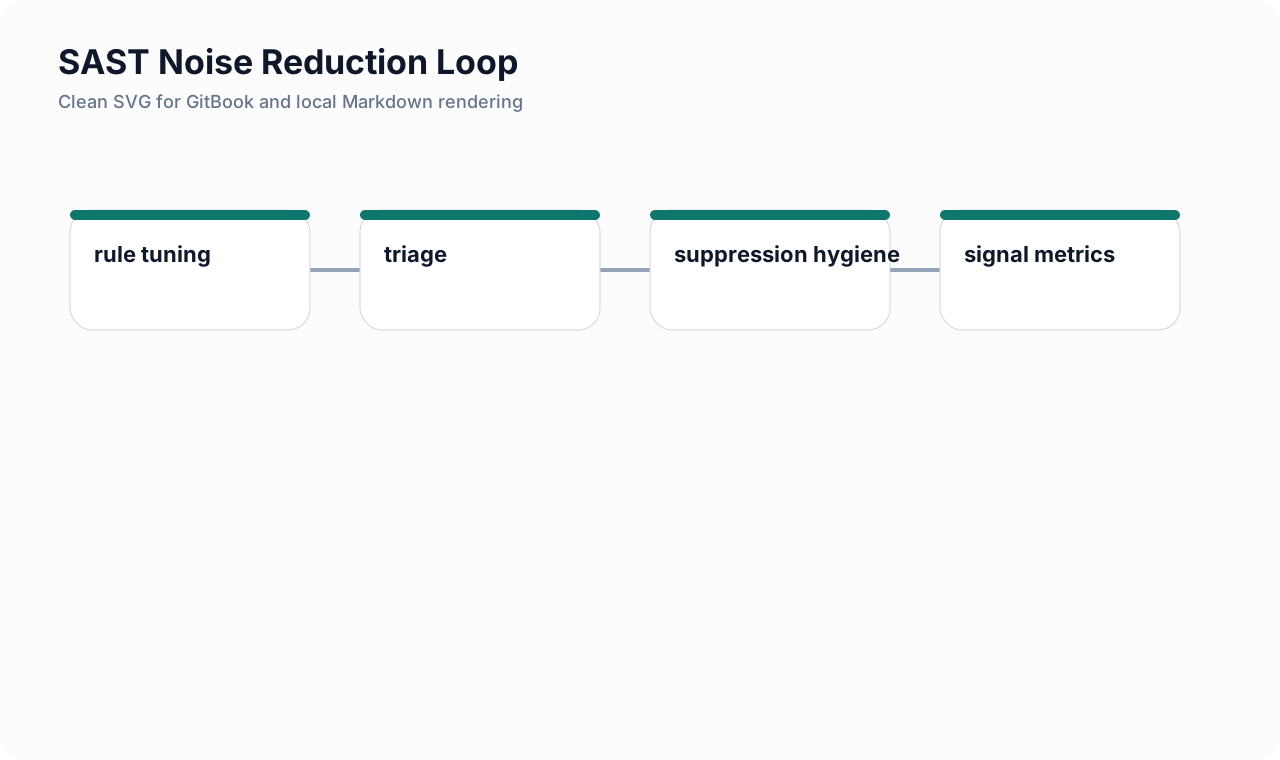
Intro: This page turns SAST tuning into an operating model instead of a collection of ad hoc suppressions. The goal is not to hide findings. The goal is to help teams see the issues that matter, trust the scanner output, and keep review effort proportional to real risk.
What this page includes
- common sources of SAST noise and duplicated friction
- a practical triage model for high-confidence, review-needed, and backlog findings
- pipeline patterns that keep developer experience usable without making the program toothless
Working assumptions
- most teams do not fail because they have no scanner; they fail because their scanner output is not actionable enough to change delivery behavior
SAST becomes valuable when it improves engineering decisions at the speed of normal development. That usually means a smaller set of precise rules for blocking paths, a broader set for review and education, and an explicit exception process that does not turn into silent debt.
What “noise” usually means
Noise is not only about false positives. In practice, SAST noise includes several different problems:
| Noise pattern | What it looks like | Why it hurts |
|---|---|---|
| Low-precision rules in blocking paths | Developers see issues they cannot reproduce or explain | Teams learn to bypass or ignore the scanner |
| Legacy debt mixed with new work | A pull request inherits hundreds of historic findings | New security work becomes emotionally and operationally impossible |
| Generated, vendored, or test code included | Findings appear in code that should not be remediated the same way as product logic | Ownership becomes unclear |
| Hotspots mixed with vulnerabilities | Review-needed warnings are treated like definite defects | Severity inflation burns attention |
| Duplicate findings across tools | The same underlying weakness appears in several systems with different identifiers | Metrics become noisy and triage work multiplies |
| Unsupported framework modeling | A scanner misunderstands a framework, sanitizer, or routing layer | Precision drops and trust drops with it |
Control objective
A mature SAST program should answer five questions clearly:
- Which findings are precise enough to block merge or release paths?
- Which findings require human review before they are labeled fix, ignore, or acceptable risk?
- Which findings belong to historic backlog rather than to the current pull request?
- Which suppressions are allowed, for how long, and with what owner?
- How do we tell whether signal quality is improving or decaying?
Practical tuning model
1. Start with precision, not coverage theater
Begin with the most precise rule packs in critical repositories and languages. Expand only after teams can explain and consistently fix the issues they already receive.
A useful baseline is:
- high-confidence security rules for blocking paths;
- extended or lower-confidence rules for review channels;
- framework-specific rules only when the framework model is actually validated in your environment;
- secret scanning and dependency scanning reported separately so they do not pollute code-level defect streams.
2. Focus blocking decisions on new or changed code
One of the cleanest ways to reduce friction is to separate new-code expectations from historic debt management.
| Decision path | Recommended stance |
|---|---|
| Pull request or merge request | Block only on a small set of precise issues in changed code |
| Nightly or scheduled branch scan | Run broader rules for trend analysis and backlog creation |
| Legacy remediation campaign | Use targeted epics or service ownership plans, not PR blocking |
This aligns with the “clean as you code” model: developers should be responsible for not adding fresh risk while the organization manages historic debt deliberately.
3. Build a real triage taxonomy
Do not let “ignored” mean everything. Use a small, auditable set of outcomes:
| State | Meaning | Required metadata |
|---|---|---|
| To fix | Confirmed issue that should be remediated | owner, due date or tracking link |
| Reviewing | Needs manual validation or context | reviewer, next action |
| Ignored - false positive | Tool is wrong in this code path | reason, supporting note, expiry review date |
| Ignored - acceptable risk | Risk accepted intentionally | approver, business reason, compensating control, expiry |
| Fixed | Issue no longer exists | closure reference |
The key design choice is that suppression without explanation is program decay.
4. Separate “hotspots” from “vulnerabilities” in communication
Some tools intentionally report review-required security-sensitive code that is not automatically a confirmed vulnerability. Those results belong in a review queue, not in a mandatory-fix queue. This distinction keeps the blocking path focused on findings with higher certainty.
5. Tune rule scope by architecture and ownership
A security rule that works well for a Java monolith may be noisy in a TypeScript service mesh, a serverless integration layer, or a generated SDK repository. Tune by:
- language and framework;
- repository criticality;
- service exposure level;
- code ownership maturity;
- evidence that developers can reliably interpret the findings.
Pipeline pattern that usually works
| Stage | What to run | What should block |
|---|---|---|
| IDE / pre-commit | very fast linting and precise local checks | almost never block globally; keep it fast |
| PR / MR | precise security rules, secrets, basic dependency checks | only high-confidence security regressions in changed code |
| Branch or nightly | broader rule suites and data collection | do not block development retroactively |
| Release review | unresolved critical or explicitly policy-violating issues | block if the exception path is missing or expired |
Example operating rules
sast_program:
  blocking_scope:
    code_scope: changed_code_only
    finding_classes:
      - high_confidence_injection
      - high_confidence_authz_bypass
      - confirmed_secret_exposure
  review_scope:
    finding_classes:
      - security_hotspot
      - medium_confidence_taint_flow
      - framework_model_needs_validation
  suppression_requirements:
    fields:
      - owner
      - reason
      - review_date
      - tracking_reference
Metrics that reveal whether noise is improving
Track a short set of quality metrics rather than only raw counts:
- percentage of blocked findings that developers later mark as false positive;
- median time from finding to triage decision;
- percentage of ignored findings with expired review dates;
- number of reopened findings after an earlier ignore decision;
- ratio of changed-code findings to historic backlog findings;
- percentage of repositories using the approved baseline query suite.
Common anti-patterns
- blocking on an oversized rule set because “more coverage looks stronger”;
- mixing vendor code, generated code, and product code in the same policy path;
- letting every team invent its own ignore vocabulary;
- keeping permanent suppressions with no owner;
- comparing tool counts across quarters without controlling for rule-pack changes;
- rolling out extended query suites everywhere before proving the default suite is trusted.
A strong target state
A strong SAST program feels boring in the best sense:
- developers know what blocks and why;
- reviewers know what needs manual validation;
- leadership can see whether exception debt is growing;
- AppSec can expand coverage without destroying trust.
Related pages
Suggested reference links
- GitHub CodeQL query suites
- About code scanning with CodeQL
- Semgrep triage and remediation
- SonarQube Clean as You Code
- SonarQube security hotspots
Author attribution: Ivan Piskunov, 2026 - Educational and defensive-engineering use.