🧱 Secure Defaults and Golden Paths for Product and Platform Teams
Intro: The fastest way to scale Product Security is not to review every decision by hand. It is to give teams a paved road: templates, defaults, controls, and evidence that make the safer path easier than the risky one.
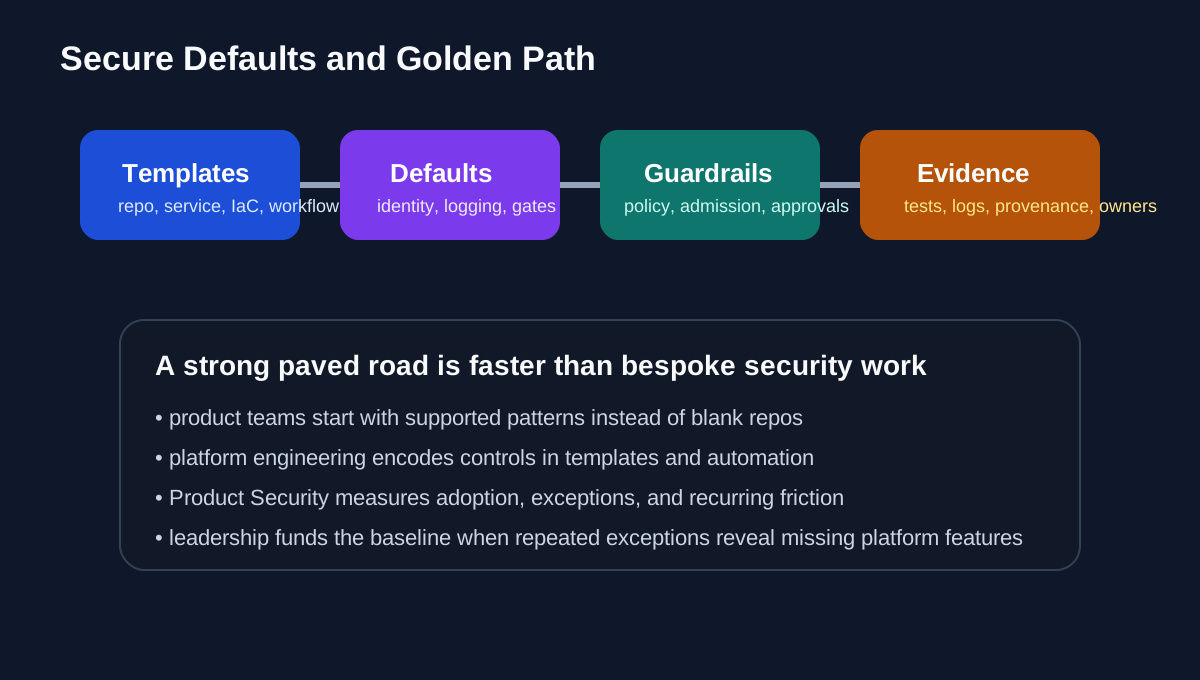
Working definition: a golden path is a supported engineering pattern that combines bootstrap templates, secure defaults, policy guardrails, observability, and an exception path.
Why golden paths matter
Without secure defaults, teams repeatedly reinvent:
- repository settings;
- CI pipelines;
- runtime identities;
- logging and alerting baselines;
- secret handling patterns;
- deployment guardrails.
That makes Product Security depend on repeated human heroics. A golden path turns those repeated decisions into standardized engineering choices.
What belongs in a real golden path
A credible golden path usually includes:
- a starter repo or service template;
- approved libraries, frameworks, and base images;
- CI checks and release gates;
- baseline runtime controls and logging;
- default ownership metadata and escalation paths;
- an exception process for cases that truly need deviation.
Reference golden paths by scenario
| Scenario | Secure defaults that should exist on day one | Evidence the path is really working |
|---|---|---|
| New internet-facing API | authn/authz scaffolding, schema validation, rate limiting, structured audit logs, secure headers | route tests, gateway policy, authz tests, access logs |
| New service repository | branch protection, CODEOWNERS, secret scanning, dependency update automation, CI permissions baseline | repo settings export, workflow review, Scorecard-style signals |
| CI pipeline with deployment rights | ephemeral credentials, protected environments, provenance/attestation, isolated runners | pipeline config, environment protections, release evidence |
| Kubernetes workload | restricted pod baseline, explicit service account, network policy, health and security telemetry | namespace labels, admission policy, RBAC manifests, runtime signals |
| Cloud workload identity | workload federation or short-lived role assumption, least privilege, audit logging, explicit trust boundaries | IAM policy review, trust-policy diff, audit logs |
| Third-party integration / webhook | outbound allow-listing, signature verification, replay protections, event audit trail | signature checks, retry handling, abuse tests |
| Sensitive data handling | data classification, encryption/key ownership, retention rules, secret injection pattern | architecture notes, KMS usage, data-flow diagram, key rotation evidence |
Golden path contract between platform and product teams
Platform promises
- maintain the templates and baseline controls;
- document supported paths and ownership;
- keep the paved road faster than bespoke bootstrapping;
- expose health and adoption metrics.
Product team promises
- use the standard path by default;
- request exceptions only when there is a concrete technical reason;
- keep service metadata, ownership, and risk records current;
- close gaps discovered by standard-path telemetry.
A practical secure-default stack
1. Repository defaults
- protected default branch;
- mandatory review for sensitive paths;
- CODEOWNERS for pipelines, infra, and authn/authz modules;
- secret scanning and dependency automation enabled by default.
2. Build defaults
- minimal CI token permissions;
- pinned or trusted reusable workflows / includes;
- signed or attested build outputs for higher-trust services;
- default scanners tuned to avoid obvious false-positive floods.
3. Deployment defaults
- staged environments with approvals for higher-risk services;
- release evidence, change tickets, or deployment records where needed;
- environment-specific secrets and identities;
- rollback path defined before first production release.
4. Runtime defaults
- workload identity rather than embedded long-lived secrets;
- baseline logs, metrics, traces, and security events;
- egress policy and namespace or account trust-tiering;
- backup and restore expectations for stateful services.
Where teams usually get this wrong
Anti-pattern 1 — the "PDF golden path"
The standard exists only as a document. There is no template, no guardrail, and no measurable adoption.
Anti-pattern 2 — the "security-only path"
The path helps security but makes engineering slower. Teams then bypass it.
Anti-pattern 3 — the "one size fits all" path
The same baseline is forced onto internal tooling, public APIs, data systems, and experiments without trust-tiering.
Anti-pattern 4 — no escape hatch
If exceptions are impossible, teams work around the standard in hidden ways.
Good places to encode the path
| Layer | Useful encoding examples |
|---|---|
| Developer portal | Backstage software templates, service catalog metadata, environment bootstrap forms |
| Source control | repository templates, branch rules, CODEOWNERS, PR templates |
| CI/CD | reusable includes, required jobs, environment protections, artifact verification |
| Kubernetes | namespace labels, admission policy, network policy, approved base manifests |
| Cloud / IaC | policy-as-code, account/project baseline modules, IAM boundary modules |
| Operations | logging defaults, dashboards, alert packs, incident labels, exception workflow |
A rollout sequence that works
- Pick one or two high-volume service types, not every workload at once.
- Build a starter template plus a short adoption guide.
- Measure adoption, escape-hatch usage, and the most common breaks.
- Fix the friction before turning the path into a “requirement.”
- Only then tie reporting and review expectations to path usage.
How to know the path is helping
Track:
- percentage of new services using the standard template;
- percentage of production services with the required metadata and logging;
- number of exceptions by golden-path category;
- time-to-first-production for teams using the path vs bespoke setups;
- repeated incidents caused by teams bypassing a standard path.
Best cross-links
- Repository Governance, CODEOWNERS, Security.md, and Default Files
- Security Quality Gates and Release Blocking
- Kubernetes Hardening
- Cloud Security Across AWS, Azure, and GCP
- Risk Acceptance, Exceptions, and Decision Records
Suggested reference links
- Backstage Software Templates — https://backstage.io/docs/features/software-templates/
- Backstage Golden Paths / adoption — https://backstage.io/docs/golden-path/adoption/getting-started/
- NIST SSDF — https://csrc.nist.gov/pubs/sp/800/218/final
- Kubernetes Pod Security Standards — https://kubernetes.io/docs/concepts/security/pod-security-standards/
- SLSA — https://slsa.dev/
- OpenSSF Scorecard — https://www.scorecard.dev/
---Author attribution: Ivan Piskunov, 2026 - Educational and defensive-engineering use.