☁️ Cloud Environment Security — IAM, Network, Storage, Service Configurations, Visibility, Posture, and Blast-Radius Control
Intro: Cloud security is not one control and not one service. It is the combined quality of your identity model, network boundaries, storage defaults, service configurations, telemetry, posture management, and the ability to keep one mistake from becoming an account-wide or organization-wide incident.
What this page includes
- a high-level domain model for cloud environment security
- practical controls for IAM, network, storage, service configuration, visibility, posture, and blast radius
- AWS-oriented examples without turning the KB into provider docs
- compact tables and review prompts
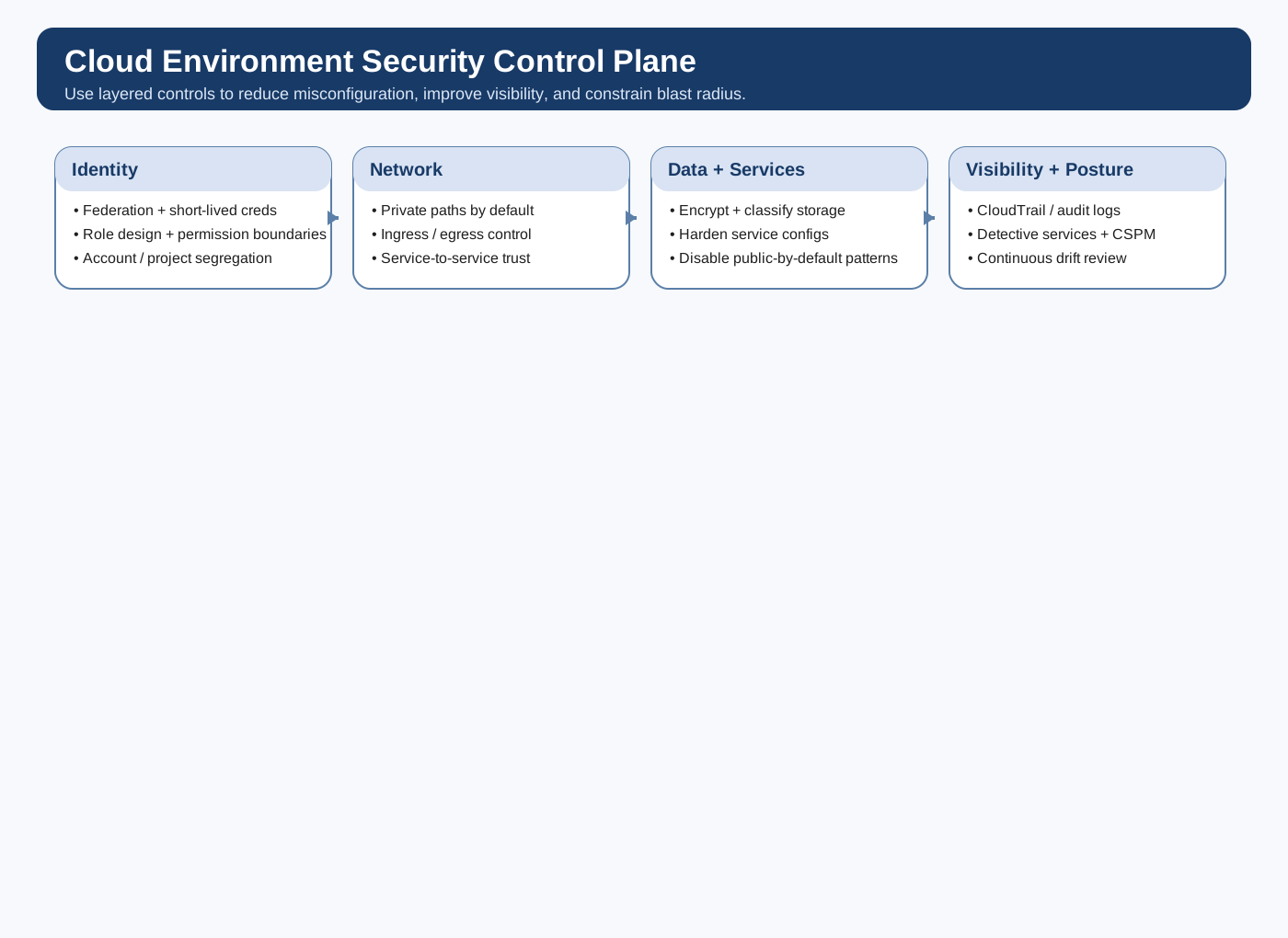
Figure: think in planes of control, not in isolated point products.
What this domain covers
| Area | What it means in practice | Typical controls | Typical failure mode |
|---|---|---|---|
| IAM | Human and workload identity, trust relationships, privileged access, and delegation | federation, SSO, short-lived credentials, scoped roles, permission boundaries, SCPs | leaked keys, over-privileged roles, unsafe trust policies |
| Network | Ingress, egress, segmentation, private connectivity, and service exposure | VPC design, SGs, NACLs, PrivateLink, VPC endpoints, WAF, API gateways | public-by-default exposure, weak egress control, unmanaged east-west trust |
| Storage and data | Data at rest, public access, encryption, backups, retention | KMS, bucket policies, public access blocks, database encryption, object lock | public buckets, weak keys, backup exposure, excessive cross-account sharing |
| Service configurations | Secure defaults and misconfiguration prevention for managed services | Config rules, baseline templates, policy-as-code, hardened modules | internet-exposed services, disabled logging, weak TLS, admin ports exposed |
| Visibility and traceability | Audit logs, alerts, asset inventory, and investigation readiness | CloudTrail / audit logs, config history, GuardDuty, Security Hub, central log archive | no central evidence, drift undetected, blind spots across accounts/regions |
| Posture management | Continuous understanding of whether the cloud estate conforms to baseline | CSPM, conformance packs, org-wide standards, drift review | false sense of security from “one-time hardening” |
| Blast-radius control | Preventing one compromised principal, workload, or account from reaching everything else | multi-account boundaries, network segmentation, JIT/JEA admin, scoped CI/CD roles | one credential opens storage, build, secrets, and production control planes |
High-level control model
1) Build a strong identity foundation
Start from identity because cloud compromise is often identity compromise.
Core controls
- centralize workforce access through federation or cloud-native SSO
- default to temporary credentials for humans and workloads
- separate workforce roles, workload roles, break-glass roles, and CI/CD roles
- use account, subscription, or project boundaries to separate production from non-production and shared services
- review trust policies, external access, and dormant permissions regularly
AWS-oriented examples
- IAM Identity Center for workforce access
- STS and assumed roles instead of long-lived keys
- Organizations + SCPs for coarse-grained guardrails
- IAM Access Analyzer for unintended access and trust review
2) Make network boundaries deliberate
Cloud networking is not just ingress filtering. It is the shape of trust between internet entry points, private services, data services, CI/CD systems, and operators.
Core controls
- expose only the edge systems that must be public
- use internal load balancers, private subnets, and service endpoints where possible
- make egress explicit for high-value workloads
- isolate control planes from application planes
- use WAF and API-layer controls for internet-facing application paths
Review prompts
- Which services are reachable from the public internet?
- Which workloads can call the control plane, metadata services, or package mirrors?
- Can a compromised app tier reach databases, queues, and secrets stores it does not own?
Example: practical AWS network guardrails
resource "aws_security_group" "app" {
  name        = "app-prod-sg"
  description = "Example app SG"
  vpc_id      = var.vpc_id

  ingress {
    description     = "Allow ALB to app"
    from_port       = 8443
    to_port         = 8443
    protocol        = "tcp"
    security_groups = [aws_security_group.alb.id]
  }

  egress {
    description = "Explicit egress only"
    from_port   = 443
    to_port     = 443
    protocol    = "tcp"
    cidr_blocks = [var.allowed_egress_cidr]
  }
}
The exact syntax will vary, but the security idea is stable: reference upstream tiers, reduce public CIDRs, and stop treating unrestricted egress as harmless.
3) Treat storage like an exposure surface, not a utility
Storage failures are often quiet and catastrophic: public buckets, overly broad cross-account access, weak backup protection, or data services reachable from the wrong trust zone.
Core controls
- encrypt at rest with managed or customer-controlled keys where appropriate
- disable public exposure by default for object storage
- review bucket and key policies as carefully as IAM policies
- classify sensitive data and separate high-sensitivity stores
- protect backups, snapshots, and replicas with the same seriousness as primary data
Simple rules that prevent common failures
- no public object storage without explicit approval and documented business reason
- no secrets in object storage used as an application configuration shortcut
- no “temporary” cross-account sharing without expiry and owner
4) Harden service configurations continuously
Managed services reduce host-level burden, but they do not remove security design work.
| Service type | High-value checks |
|---|---|
| Compute / serverless | runtime role scope, environment variable handling, logging enabled, network placement, internet reachability |
| Databases | public exposure disabled, auth model reviewed, backups enabled, TLS required, admin paths restricted |
| Storage | public access block, encryption, policy review, access logging, lifecycle retention |
| Messaging / queues | producer/consumer authorization, dead-letter handling, encryption, cross-account trust review |
| Container platforms | cluster API exposure, IAM integration, admission policy, node auth, image provenance, log retention |
| CI/CD-connected services | deployment role scope, artifact trust, environment protection, audit logging |
5) Build visibility before you need incident response
Cloud-native incidents are hard to reconstruct without durable logs, configuration history, and asset context.
Minimum visibility baseline
- organization-wide audit trails and config history
- central log archive account or equivalent protected destination
- detection for identity abuse, anomalous API activity, and public exposure
- inventory of accounts, services, internet-facing endpoints, keys, and privileged roles
- investigation-friendly correlation between cloud logs and CI/CD / identity events
AWS-oriented examples
- CloudTrail for API events
- AWS Config for configuration state and drift
- GuardDuty for threat detections
- Security Hub for findings aggregation
- Inspector / Macie where they fit your estate and data model
6) Use posture management to continuously compare reality with baseline
Posture management is the feedback loop. It answers: is the environment still shaped like the design intended?
Good posture management looks like
- controls defined as code or reusable modules
- severity and ownership attached to posture findings
- time-bounded exceptions
- drift triaged by business impact and exploitability, not by raw finding count alone
Bad posture management looks like
- screenshot-based compliance
- no owner for findings
- “critical” findings sitting open for months because nothing is tied to release or operational incentives
7) Design for blast-radius reduction
Blast radius is the size of the failure domain when something goes wrong.
| Blast-radius pattern | Why it helps |
|---|---|
| Separate production accounts / projects | limits lateral movement and administrative mistakes |
| Distinct CI/CD roles per environment | prevents one pipeline compromise from owning everything |
| Dedicated log archive and security tooling accounts | protects evidence and control functions from tampering |
| Private data paths | reduces accidental or malicious direct reachability |
| JIT or break-glass admin access | reduces standing privilege |
| Service-specific roles and narrow trust policies | limits what one compromised workload can do |
| Explicit egress paths | constrains exfiltration and hidden dependencies |
Example review table for AWS-focused environments
| Domain | Core AWS-native controls | Common review questions |
|---|---|---|
| IAM | IAM Identity Center, STS, SCPs, Access Analyzer | Are long-lived keys still needed? Which roles can mutate production? |
| Network | VPC, SGs, NACLs, PrivateLink, WAF, API Gateway | What is public? What can talk east-west? What can egress freely? |
| Storage | S3 block public access, KMS, bucket policies, Macie | Which stores hold regulated or customer-sensitive data? |
| Service config | AWS Config, hardened templates, baseline Terraform modules | Which services are internet-facing, under-logged, or using default settings? |
| Visibility | CloudTrail, Security Hub, GuardDuty, Inspector | Can you answer who changed what, where, and when? |
| Blast radius | Organizations, separate accounts, deployment role separation | Could one compromised CI token or admin session reach all environments? |
Two simplified field examples
Example 1 — the “one role to rule them all” problem
A team uses one broad deployment role for dev, staging, and prod because it is fast. That role can also read secrets and update bucket policies. A pipeline token leaks. The immediate issue is not only malicious deployment. The real issue is shared blast radius: the same principal can alter workloads, storage exposure, and credentials across environments.
Fix direction: environment-scoped roles, protected environments, explicit approval boundaries, and separate secret access paths.
Example 2 — quiet storage exposure
A reporting bucket was created for external sharing and later reused for internal data exports. Public access settings stayed permissive, and object naming became obscure enough that nobody noticed. The incident is not “an S3 problem”; it is a data lifecycle + ownership + drift problem.
Fix direction: bucket ownership, classification, block-public-by-default, periodic access review, and drift alerts.
Minimal cloud environment review checklist
- Are human identities federated and workload identities short-lived?
- Are production and non-production separated by real boundaries, not naming conventions?
- Is public access explicit, owned, and justified?
- Can the team trace API activity and configuration drift centrally?
- Are posture findings assigned to owners with deadlines and exception handling?
- Could one principal, token, or role compromise more than one trust zone?
References and best-practice anchors
Keep this KB page short and use these for deeper provider detail:
- AWS Well-Architected Framework — Security Pillar
- AWS Organizations and SCP guidance
- IAM Access Analyzer
- AWS Config / Security Hub / GuardDuty / Inspector / Macie docs
- NIST SSDF and OWASP guidance for delivery-plane interactions with cloud environments