🧭 Frontend Security Review Playbook
Intro: A frontend security review should not stop at “looks fine” because modern risk usually hides in state transitions, browser trust assumptions, partner scripts, and file handling. This playbook gives reviewers a repeatable way to inspect the browser-facing part of a product without drifting into vague advice.
What this page includes
- a practical review flow for web frontends and BFF-backed experiences
- what to inspect in auth, state, storage, rendering, and integrations
- evidence reviewers should ask for before approving release
- common anti-patterns and a decision matrix for escalation
Use this review when
Use this page when a team introduces one or more of the following:
- a new login, session, or logout flow;
- a new frontend framework or rendering mode;
- browser-side token handling;
- a payment, support, analytics, or chat widget;
- a high-risk upload, export, or document-viewing experience;
- a feature where tenant data can be viewed, exported, or delegated.
Review order
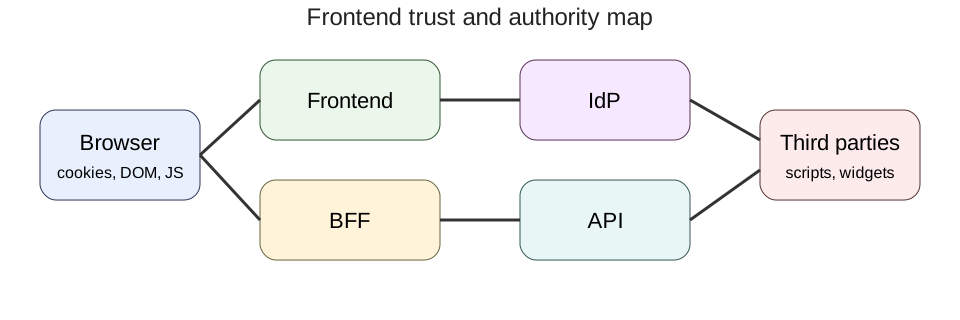
1. Map the trust boundaries first
Draw the request path and mark:
- the browser;
- the frontend application;
- the BFF, if one exists;
- the identity provider;
- the API gateway and backing APIs;
- third-party origins loaded as scripts, frames, images, fonts, or APIs.
If the team cannot explain where authority actually lives, the review is not ready to approve.
2. Identify the browser-held authority
Ask these questions first:
- What credentials or session material exist in the browser?
- Which of them can JavaScript read?
- Which actions can the browser perform directly versus only through a BFF?
- Which claims are only decorative in the frontend and which are server-authoritative?
Preferred bias: keep high-value authority in a server-controlled trust boundary and make the browser present intent rather than hold broad privilege.
3. Walk the rendering model
The rendering model changes the attack surface:
| Mode | Reviewer focus |
|---|---|
| Static frontend | secrets in build output, API exposure, CDN and header behavior |
| SPA | token location, route protection assumptions, API origin exposure |
| SSR | cache separation, response header policy, request smuggling assumptions |
| Hybrid/ISR/edge | per-request personalization boundaries, nonce/header handling, stale-cache leakage |
4. Inspect browser controls
A high-value release should have explicit decisions for:
- cookies:
Secure,HttpOnly,SameSite, scope, lifetime; - CSP: script strategy, frame strategy, reporting, exception inventory;
- CORS: exact origins, credential usage, preflight behavior;
- framing:
frame-ancestorsor equivalent; - download behavior: inline render versus forced download;
- storage: what lives in cookies, memory,
sessionStorage, orlocalStorage.
5. Inspect dangerous feature classes
Pay extra attention when the frontend can:
- upload files;
- render user-supplied HTML or rich text;
- start exports or bulk actions;
- embed support or analytics tools;
- call administrative APIs;
- manage organization settings, members, billing, or secrets.
Review checklist by topic
Authentication and session handling
Verify:
- login, refresh, and logout flows are consistent across tabs and devices;
- session invalidation works after password reset, MFA reset, and role change;
- the frontend does not trust its own route guards as the final authorization decision;
- logout clears the session from the browser and from the server-side session model;
- BFF routes reject direct cross-site abuse and do not accept confused-deputy behavior.
State and storage
Reviewers should reject or escalate if they find:
- long-lived bearer tokens in
localStoragewithout a strong justification; - secrets, API keys, or private environment values shipped in the bundle;
- entitlement checks implemented only in JavaScript;
- client-side feature flags exposing sensitive rollout logic.
Browser rendering and DOM risk
Look for:
- direct DOM sinks such as
innerHTML, unsafe markdown rendering, template injection, or untrusted HTML display; - dangerous file preview behavior;
- missing sanitization for rich text, comments, knowledge-base articles, templates, or email previews;
- support tools that can read full DOM state on authenticated pages.
Third-party scripts and widgets
Before approval, require:
- an owner for each script or widget;
- allowed data access documented;
- removal/disable path documented;
- CSP allowance explained;
- impact if the provider is compromised or starts collecting more data than expected.
Evidence reviewers should request
Ask the team for concrete proof, not only statements:
- production or staging response headers from real endpoints;
- screenshots or docs showing cookie attributes;
- a list of allowed origins and why they exist;
- a short CSP violation sample or reporting dashboard snapshot;
- a bundle or code grep showing that secrets are not compiled into the client;
- a short flow diagram for login, token refresh, logout, and privileged action confirmation.
Escalation triggers
Escalate the review if any of the following is true:
- the browser can directly call privileged upstream APIs;
- the team needs broad
unsafe-inlineor broad wildcard script sources in CSP; - session or token invalidation behavior is unclear;
- tenant data export or admin actions are browser-mediated without server-side re-verification;
- the frontend can render attacker-controlled files inline;
- support tooling or marketing tooling has read access to highly sensitive pages.
Bad versus better patterns
Bad: frontend decides authorization
// Anti-pattern: route or UI state implies permission.
if (currentUser.role === 'admin') {
  showBillingExportButton();
}
Better: frontend presents intent, backend enforces policy
// Safer pattern: the frontend may hide or show UI,
// but the backend remains the source of truth.
const canExport = await api.get('/me/permissions/billing-export');
if (canExport.allowed) {
  showBillingExportButton();
}
The frontend can improve usability, but it must not be the last control.
Review close-out
Approve only when the team can answer:
- Which authority lives in the browser?
- Which actions require server-side re-verification?
- Which origins, scripts, and files are trusted, and why?
- Which telemetry would show abuse later?
Related pages
- Browser Security Foundations: CSP, CORS, Cookies, and Sessions
- OAuth for SPA, BFF, and Frontend Secret Anti-Patterns
- Third-Party Scripts, File Handling, and Frontend Supply Chain
- Security Headers and Reference Configurations
- File Upload, Download, and Browser Rendering Risks
Author attribution: Ivan Piskunov, 2026 - Educational and defensive-engineering use.