🧠 Business Logic Abuse Review Playbook
Intro: Business logic abuse is where secure code and secure infrastructure still fail because the workflow itself can be manipulated. This is one of the highest-value review skills for Product Security because it connects security directly to money, tenancy, trust, and customer harm.
What this page includes
- a repeatable workflow for business-logic abuse reviews
- how to find profitable and scalable abuse paths
- review questions for signup, billing, sharing, support, and admin workflows
- detective controls and release gates that make abuse visible
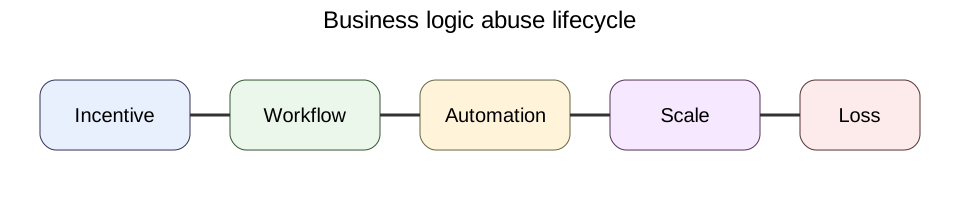
Start with the attacker’s economic question
Ask:
- What makes this workflow profitable?
- What makes it scalable?
- What makes it hard for the business to notice quickly?
The most dangerous product abuse paths usually have all three properties.
Review method
1. Identify the critical business objects
Typical examples:
- account;
- tenant;
- invite;
- coupon or credit;
- export job;
- support impersonation session;
- subscription state;
- admin or delegated role;
- recovery artifact.
2. Map each state transition
For each object, list:
- who can create it;
- who can read it;
- who can mutate it;
- who can delete it;
- what automation, retries, imports, or webhooks can affect it.
3. Ask how a script would abuse it
This is where teams often discover the real issue.
Questions:
- Can the workflow be repeated cheaply?
- Can it be distributed across many accounts, IPs, or tenants?
- Can the attacker use legitimate APIs rather than exploit low-level bugs?
- Can support or admin workflows bypass normal friction or logging?
High-risk workflow families
Account creation and growth loops
Examples:
- disposable account farms;
- trial resets;
- referral abuse;
- invite amplification;
- coupon stacking or sequencing;
- recovery flows used to take over dormant accounts.
Object access and sharing loops
Examples:
- predictable or weak share links;
- export APIs scoped only by client-provided object identifiers;
- bulk operations that skip per-object verification;
- support users or integrations that can cross tenant boundaries.
Financial and quota workflows
Examples:
- race conditions around credits or seat provisioning;
- downgrade or cancellation timing abuse;
- refunds and replays;
- quota reset edge cases;
- usage metering blind spots.
Review questions by role
For engineering
- What is the server-side source of truth for ownership and eligibility?
- Which steps are re-verified at execution time versus assumed from UI flow?
- Which APIs can be scripted at high volume?
For product
- What friction is acceptable for risky flows?
- Which abuse path would hurt revenue or trust the fastest?
- Which customer-facing notifications should exist after sensitive events?
For support and operations
- Which tools bypass the normal workflow?
- Which actions are dual-controlled, logged, or time-limited?
- Which recovery or impersonation paths are likely to be socially engineered?
Minimum detective controls
A business-logic abuse review should define at least some of the following:
- event logs for object creation, sharing, export, invite, quota change, and billing change;
- anomaly alerts for impossible or high-volume workflow sequences;
- tenant-aware detections for cross-object access attempts;
- user-visible notifications after high-risk changes;
- dashboards that correlate account creation, usage, and failure patterns.
Release gate ideas
Do not rely on scanners alone. Add review gates such as:
- explicit approval for new admin or support bypass features;
- abuse review required for new bulk export or invite flows;
- quota and anti-automation design required for self-service signup and trial features;
- tenant-boundary test evidence attached before release.
Related pages
- Signup, Trial, Promo, and Business-Flow Abuse
- Support, Admin, and Recovery Flow Abuse
- Rate Limits, Quotas, Friction, and Detection
- Tenant Isolation, Object-Level, and Workflow Abuse
Author attribution: Ivan Piskunov, 2026 - Educational and defensive-engineering use.