🛣️ Application Security Engineer Learning Roadmap (2026)
Intro: AppSec is often misunderstood as “pentesting plus scanners.” That is too narrow. Real AppSec work sits between engineering, product risk, code review, architecture, and secure delivery. This page synthesizes multiple public AppSec roadmaps into one practical development path for newcomers and junior engineers.
What this page includes
- a realistic AppSec learning order;
- a role map for people coming from development, pentest, or platform backgrounds;
- a 12-week starter plan;
- portfolio ideas that prove you can review and improve real systems.
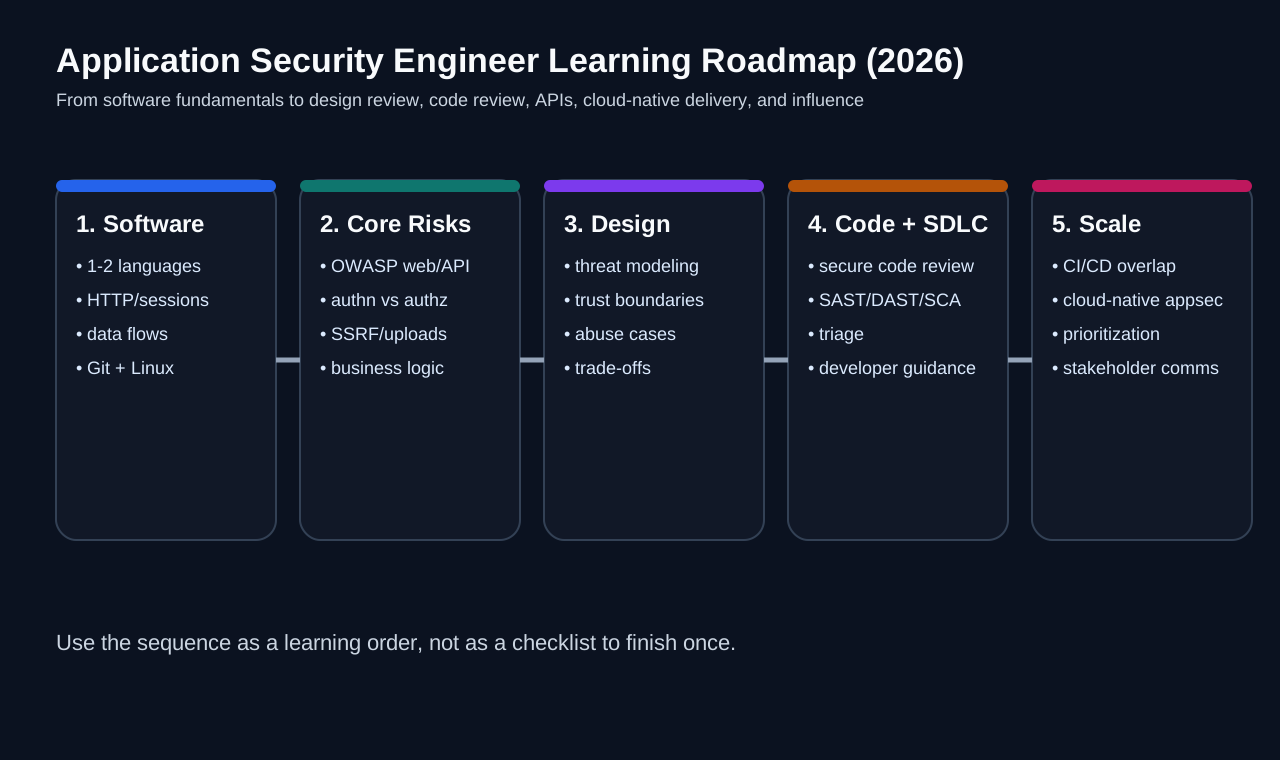
Figure: a practical sequence from software foundations to threat modeling, code review, APIs, DevSecOps, and program influence.
Source inputs used for this synthesis
This page blends ideas from:
- Cybr’s AppSec Engineer career path and the linked visual roadmap;
- Cybr-Inc/appsec-engineer-roadmap;
- Pedro Ketzer’s roadmap-appsec;
- jassics/security-study-plan and its application-security study plan;
- fosres/AppSec-Plan;
- paragonie/awesome-appsec as a discovery layer for deeper reading and self-study.
What AppSec actually is
Application Security is the discipline of making software harder to misuse, easier to review, and safer to change.
That usually includes:
- design review and threat modeling;
- secure coding guidance;
- code review and vulnerability triage;
- SAST / DAST / SCA placement and tuning;
- API and authorization review;
- release-gate and remediation workflows;
- coaching engineers without turning every issue into a security ticket war.
It is not only offensive testing, and it is not only tool administration.
The seven-layer learning order
1) Software and protocol foundations
AppSec is easier when you can think like the developers you support.
Focus on:
- one or two programming languages deeply;
- HTTP, sessions, cookies, tokens, and browser trust;
- relational and non-relational data basics;
- input handling, serialization, parsers, and file-processing risk;
- Git and normal engineering workflows;
- Linux basics and service deployment vocabulary.
Practical signal of progress
- you can read a code path and understand what state changes, what authority is checked, and where untrusted data enters.
2) Web, API, and identity fundamentals
This is the first security-heavy layer.
Focus on:
- OWASP Top 10 for web and APIs;
- authentication vs authorization;
- object-level and workflow-level access control;
- session management and token misuse;
- SSRF, deserialization, upload, parser, and business-logic risk;
- API contract security and schema discipline.
3) Secure design and threat modeling
Good AppSec work begins before code lands.
Focus on:
- assets, actors, trust boundaries, and abuse cases;
- data flows and where authority changes happen;
- secure defaults and compensating controls;
- architectural decision records and review notes;
- when to block, when to recommend, and when to accept residual risk.
4) Code review and secure coding guidance
This is the layer that many aspiring AppSec engineers underestimate.
Learn to review:
- validation and normalization logic;
- dangerous sinks and framework-specific misuse;
- authorization checks at object and business-flow level;
- crypto use and secret handling;
- logging and error-handling exposure;
- framework defaults that silently weaken security.
Your goal is not only “find the bug.”
Your goal is “explain the bug, the exploit path, and the engineering fix.”
5) SDLC, tooling, and developer enablement
Once you understand code and design, learn how to scale the practice.
Focus on:
- SAST, DAST, SCA, secret scanning, and SBOM concepts;
- noise reduction and triage discipline;
- secure coding training patterns;
- PR-time vs build-time vs release-time controls;
- vuln-management workflows and SLA context;
- how to write guidance developers can actually use.
6) Cloud-native AppSec and DevSecOps overlap
Modern AppSec is not complete without delivery context.
Focus on:
- CI/CD trust boundaries;
- container and Dockerfile review basics;
- workload identity and secret distribution;
- Kubernetes and cloud exposure paths that originate from application design;
- API gateways, WAFs, and edge controls as compensating—not magical—controls.
7) Communication, prioritization, and product influence
This is the difference between a bug finder and a strong AppSec engineer.
Learn to:
- write findings in engineering language;
- prioritize by exploitability, exposure, and business effect;
- communicate to product teams and managers differently;
- defend security changes with trade-off awareness;
- propose phased fixes instead of abstract ideals only.
Which starting background changes the path?
Developer-to-AppSec
Your advantage:
- code comprehension and delivery empathy.
You usually need to accelerate:
- attacker thinking;
- authz abuse patterns;
- vuln taxonomy and triage discipline.
Pentester-to-AppSec
Your advantage:
- offensive intuition and exploit-path thinking.
You usually need to accelerate:
- software design review;
- code-reading depth;
- SDLC workflow and developer enablement.
DevOps / platform-to-AppSec
Your advantage:
- CI/CD, cloud, and deployment context.
You usually need to accelerate:
- application-layer authz and business-logic review;
- secure coding guidance;
- feature-level risk translation.
12-week starter plan
| Weeks | Focus | Read and practice | Outcome |
|---|---|---|---|
| 1-2 | engineering fundamentals | one language deeply, HTTP, sessions, data flow, Git | can read application behavior, not only attack names |
| 3-4 | web + API risks | OWASP web/API issues, authn/authz, SSRF, file handling, business logic | can explain common exploit paths clearly |
| 5-6 | threat modeling + secure design | trust boundaries, abuse cases, design-review notes | can participate usefully in architecture review |
| 7-8 | code review | secure coding patterns, framework misuse, authorization review | can review a PR or code path with useful findings |
| 9-10 | tooling + SDLC | SAST/SCA/DAST/secret scanning, triage, developer guidance | can place tools into workflow without magical thinking |
| 11 | cloud-native overlap | CI/CD trust, container basics, workload identity, release risk | can connect application issues to platform blast radius |
| 12 | communication + prioritization | findings, remediation guidance, leadership translation | can write findings that engineers and managers both understand |
Portfolio projects that prove real AppSec skill
1) Threat model plus design review note
Take one sample service and produce:
- a short DFD or trust-boundary map;
- abuse cases;
- top three design risks;
- recommended design changes.
2) Code review pack
Review one intentionally vulnerable application and create:
- code-path notes;
- vulnerability writeups;
- remediation suggestions;
- one “what to teach developers” section.
3) API review pack
Use an OpenAPI-based demo and produce:
- contract lint output;
- auth and authz observations;
- missing schema / trust issues;
- release-gate recommendations.
4) AppSec-in-pipeline demo
Create a small repository with:
- secret scanning;
- SAST;
- dependency review;
- one DAST or contract check;
- a short triage matrix that explains what blocks a release and what does not.
Common traps
- thinking AppSec is only web exploitation;
- learning dozens of tools before learning code and design review;
- prioritizing CVSS labels over exploit path and business context;
- writing findings that explain the bug but not the engineering change;
- never learning how cloud, CI/CD, and workload identity affect application risk.
Good companion pages in this KB
- Threat Modeling Methods and Workflows
- API Security in Action — Modern Patterns and Review Questions
- Web Application Security Review and Architecture Playbook
- SAST Noise Reduction
- Business Logic Vulnerabilities and Verification
- Product Security Ramp-Up Tracks
Public references
- https://github.com/Cybr-Inc/appsec-engineer-roadmap
- https://cybr.com/career-paths/application-security-appsec-engineer/
- https://github.com/PedroKetzer/roadmap-appsec
- https://github.com/jassics/security-study-plan/blob/main/application-security-study-plan.md
- https://github.com/fosres/AppSec-Plan
- https://github.com/paragonie/awesome-appsec
- https://github.com/jassics/security-study-plan
---Author attribution: Ivan Piskunov, 2026 - Educational and defensive-engineering use.