🛣️ DevSecOps Engineer Learning Roadmap (2026)
Intro: Most DevSecOps roadmaps look like giant tool lists. That is useful for discovery, but not for learning order. This page synthesizes the public roadmap material into a path that helps a newcomer or junior engineer build judgment, not only memorize tool names.
What this page includes
- a practical learning sequence for DevSecOps newcomers;
- a role map from foundations to platform-scale operating judgment;
- a 12-week starter plan;
- portfolio ideas that demonstrate real capability instead of keyword familiarity.
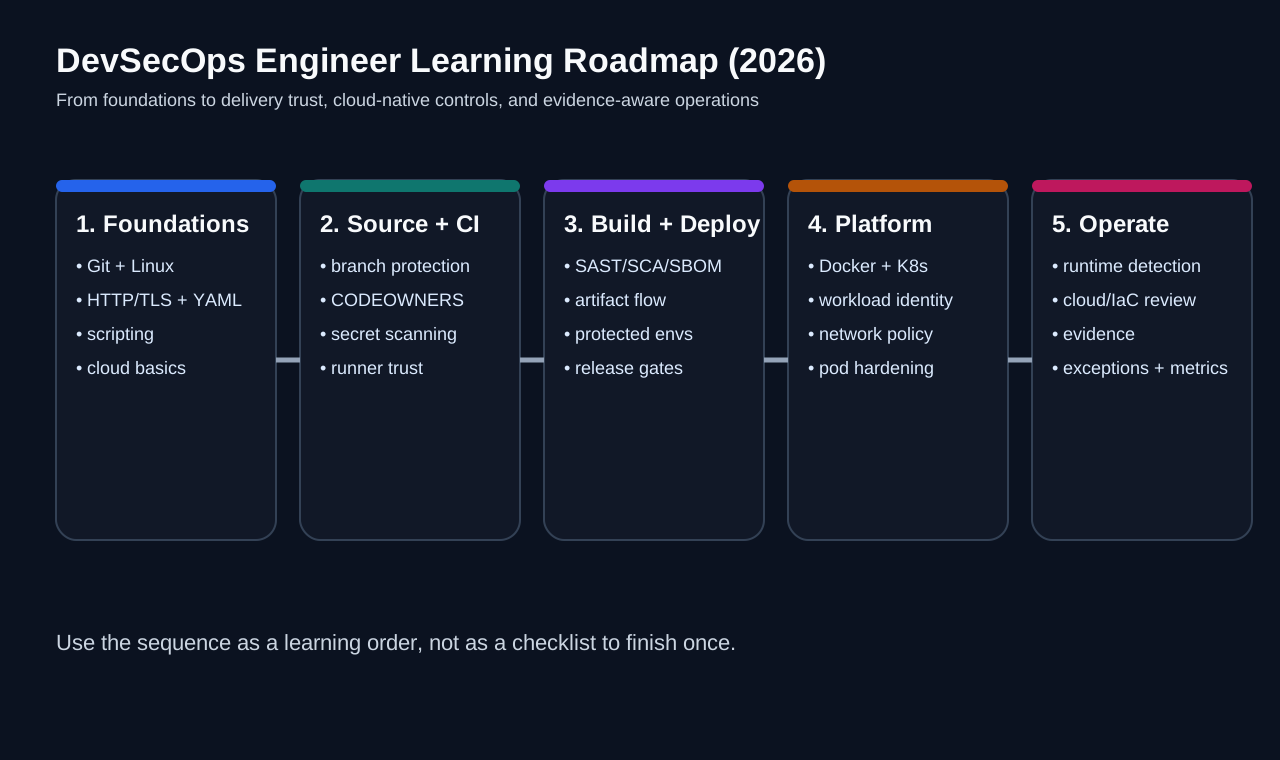
Figure: a compact visual path from foundations to cloud, Kubernetes, runtime, and evidence-aware delivery.
Source inputs used for this synthesis
This page consolidates ideas from:
- roadmap.sh DevSecOps roadmap;
- hahwul/DevSecOps;
- kh4sh3i/DevSecOps;
- nxenon/DevSecOps;
- The_DevSecOps_Series by Manthan Dhole;
- related study-plan style repositories that separate AppSec, cloud, Kubernetes, and pipeline work into distinct tracks.
The shortest correct mental model
A strong DevSecOps engineer is not “the scanner person.”
They are the person who can explain and improve the trust boundaries from commit to runtime.
That usually means being able to answer questions such as:
- who can change source, pipeline, artifact, deployment, and production policy;
- where secrets or short-lived identities appear in that flow;
- what evidence proves a release was built and deployed correctly;
- how a cloud or Kubernetes misconfiguration turns a small mistake into a bigger incident;
- which controls belong in developer tooling, which belong in CI/CD, and which belong in runtime or platform defaults.
The six-layer learning order
1) Engineering and platform foundations
Start here even if your end goal is security tooling.
You need working comfort with:
- Git and pull-request workflows;
- Linux basics, shell usage, package management, and process inspection;
- HTTP, TLS, DNS, networking basics, and reverse proxies;
- one scripting language you can automate with confidently, usually Python or Bash;
- basic cloud and container vocabulary;
- YAML, JSON, and how configuration mistakes actually happen.
Practical signal of progress
- you can read a pipeline file, Dockerfile, or deployment manifest without feeling lost;
- you can explain what a job, runner, image, role, service account, or namespace is doing.
2) Source control and repository trust
Before scanning anything, learn the control points around source.
Focus on:
- branch protection and required review;
- CODEOWNERS and repo ownership;
- signed commits and verified identities where justified;
- repo-level secrets scanning;
- dependency update automation;
- default repository templates and baseline files.
What juniors often miss DevSecOps starts before CI. Unsafe repository defaults scale mistakes across every later stage.
3) Build and CI/CD trust boundaries
This is the center of the role.
Learn how to reason about:
- runner isolation;
- ephemeral vs persistent build workers;
- secret injection patterns;
- protected variables and environments;
- artifact creation, retention, and promotion;
- SAST, SCA, SBOM, and secret-scanning placement;
- release gates and exceptions.
Key question If a pipeline job is compromised, what identities, artifacts, or deployment paths become reachable?
4) Containers, Kubernetes, and runtime posture
Once you understand delivery trust, move into runtime.
Focus on:
- Dockerfile hygiene and minimal images;
- image scanning and signing;
- admission policy basics;
- namespace and RBAC segmentation;
- workload identity instead of long-lived secrets;
- network policies and pod hardening;
- runtime detection basics.
This is where DevSecOps starts to overlap heavily with platform security.
5) Cloud and infrastructure as code
A mature DevSecOps engineer must understand how delivery touches cloud control planes.
Focus on:
- Terraform or another IaC workflow;
- least-privilege role design;
- workload federation / OIDC trust patterns;
- storage, registry, and secret-store exposure;
- cloud audit trails and posture findings;
- how metadata services and workload identities are abused.
6) Evidence, governance, and operating loops
This is what separates mid-level from senior judgment.
Learn how to produce and review:
- release evidence;
- provenance / attestation concepts;
- exception records;
- remediation workflows and ownership;
- simple metrics that show whether controls are working;
- audit-friendly artifacts that do not create paperwork theater.
A senior DevSecOps engineer does not only add controls. They make controls repeatable, explainable, and reviewable.
Role progression map
| Level | What to optimize first | Typical outputs |
|---|---|---|
| Beginner | understand the delivery flow and dangerous defaults | notes from one repo, one pipeline, one deployment flow |
| Junior | baseline repo, CI, secret, image, and IaC checks | PR comments, lint rules, pipeline jobs, baseline docs |
| Mid-level | reusable controls and trust-boundary reduction | shared templates, central policies, rollout playbooks |
| Senior | operating model and exception-aware scale | platform defaults, decision records, evidence patterns, metrics |
12-week starter plan
| Weeks | Focus | Read and practice | Outcome |
|---|---|---|---|
| 1-2 | foundations | Git, Linux, HTTP/TLS, YAML/JSON, one scripting language | can navigate the delivery stack without translation help |
| 3-4 | repo trust | branch protection, CODEOWNERS, secret scanning, dependency automation | can review source-control security defaults |
| 5-6 | CI/CD trust | runners, protected environments, secret handling, SAST/SCA/SBOM placement | can explain commit-to-deploy trust boundaries |
| 7-8 | containers + Kubernetes | Dockerfile review, image trust, pod security, RBAC, network policy | can review cluster-bound workload delivery risk |
| 9-10 | cloud + IaC | Terraform checks, workload identity, least privilege, metadata abuse, posture findings | can connect app or pipeline issues to cloud blast radius |
| 11 | runtime + detection | runtime investigation, logging, high-signal detections, containment basics | can predict what telemetry matters after a compromise |
| 12 | evidence + presentation | release evidence, exceptions, short leadership summary | can explain both engineering and assurance value |
Portfolio projects that prove useful DevSecOps skill
Do not build a portfolio of screenshots only. Build small, reviewable systems.
1) Secure reference repository
Create one demo repo with:
- protected branch strategy;
- CODEOWNERS;
- secret scanning;
- dependency updates;
- one pipeline that fails on high-risk findings.
2) Signed container release path
Build one containerized sample app with:
- Dockerfile linting;
- image scan step;
- SBOM generation;
- image signing or attestation demo;
- deployment approval checkpoint.
3) Kubernetes baseline pack
Create a small manifest pack that includes:
- pod security defaults;
- namespace segmentation;
- network policy baseline;
- admission-policy test examples;
- runtime review notes.
4) Cloud + IaC review pack
Build or fork a small Terraform stack and show:
- policy scan output;
- least-privilege role improvement;
- public exposure review;
- remediation notes and a short exception example if something is intentionally deferred.
Common traps
- trying to master five scanners before understanding the delivery path;
- treating Jenkins/GitHub Actions/GitLab syntax as the same thing as security architecture;
- focusing on CVE counts while ignoring identity, secret, and promotion trust;
- learning Kubernetes commands without learning how cluster access is granted;
- producing evidence only for auditors instead of for incident response and engineering review too.
Good companion pages in this KB
- DevSecOps Playbook Domains, Priority, Difficulty, and Adoption Roadmap
- Commit to Deployment Security Control Plane
- Runner Isolation and Trust Boundaries
- Infrastructure as Code Maturity and Test Strategy
- Kubernetes Review Map — CKS Domains and Modern Attack Paths
- Product Security Tooling Landscape and Inventory
Public references
- https://roadmap.sh/devsecops
- https://github.com/hahwul/DevSecOps
- https://github.com/kh4sh3i/DevSecOps
- https://github.com/nxenon/DevSecOps
- https://github.com/ManthanDhole/The_DevSecOps_Series
- https://github.com/jassics/security-study-plan
---Author attribution: Ivan Piskunov, 2026 - Educational and defensive-engineering use.