🛣️ Maturity Roadmaps and Transformation Plans
Intro: Mature Product Security programs do not improve by declaring ambition. They improve by defining which capabilities should exist at each stage, who owns them, and what evidence proves the stage is real.
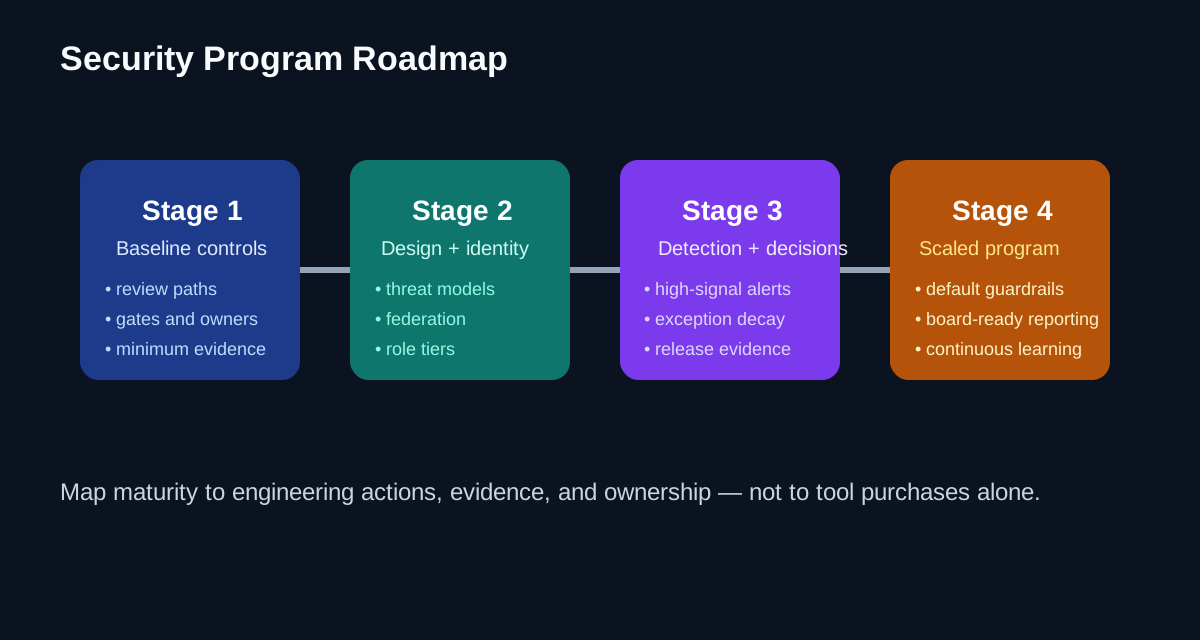
Figure: staged maturity progression from baseline controls to measured operating model.
Use maturity models as translation layers, not as trophies
Useful frameworks include:
- NIST SSDF for secure software development practice structure;
- OWASP SAMM for balanced software assurance program improvement;
- BSIMM for benchmark framing against observed mature practice;
- OWASP ASVS for application verification depth;
- SLSA for artifact integrity and supply chain assurance.
The point is not to “become compliant with the framework.” The point is to map framework language to:
- engineering actions;
- ownership;
- evidence;
- review cadence;
- quarter-by-quarter improvement.
Example four-stage roadmap
Stage 1 — baseline control establishment
- minimum secure SDLC expectations;
- basic CI security gates;
- baseline cloud and Kubernetes controls;
- defined intake paths;
- named owners for exceptions and major reviews.
Stage 2 — design and identity maturity
- structured threat modeling;
- workload federation replacing static deployment keys;
- stronger admin access model;
- reusable reference architectures;
- material services categorized by risk tier.
Stage 3 — detection and decision maturity
- high-signal detection catalog;
- business-abuse telemetry and response;
- reliable release evidence;
- exception renewal discipline;
- leadership reporting tied to exposure and trend.
Stage 4 — scaled operating model
- platform defaults cover common risk paths;
- review capacity focused on ambiguity and exceptions;
- metrics guide budget and roadmap decisions;
- incidents feed directly into standards and learning paths.
Roadmap planning questions
- Which capability reduces the most recurring risk this quarter?
- Which capability reduces repeated manual review work?
- Which capability unlocks several later controls?
- Which capability needs leadership sponsorship rather than security effort alone?
What not to do
- do not attempt to advance every maturity dimension equally;
- do not present maturity scores without concrete capability evidence;
- do not confuse deployment of a tool with adoption of a control.
Suggested references
- NIST SSDF — https://csrc.nist.gov/projects/ssdf
- OWASP SAMM — https://owasp.org/www-project-samm/
- OWASP ASVS — https://owasp.org/www-project-application-security-verification-standard/
- SLSA — https://slsa.dev/
Cross-links
- Product Security Maturity, Scale, and Business Translation
- Metrics and Reporting
- BSIMM and OWASP SAMM for Product Security Leaders
- Product Security Ramp-Up Tracks
Author attribution: Ivan Piskunov, 2026 - Educational and defensive-engineering use.