🧾 Risk Acceptance and Exception Governance — Operating Model
Intro: Exceptions are not an administrative afterthought. They are one of the clearest ways a Product Security program shows whether it can turn risk into visible, owned, time-bound decisions.
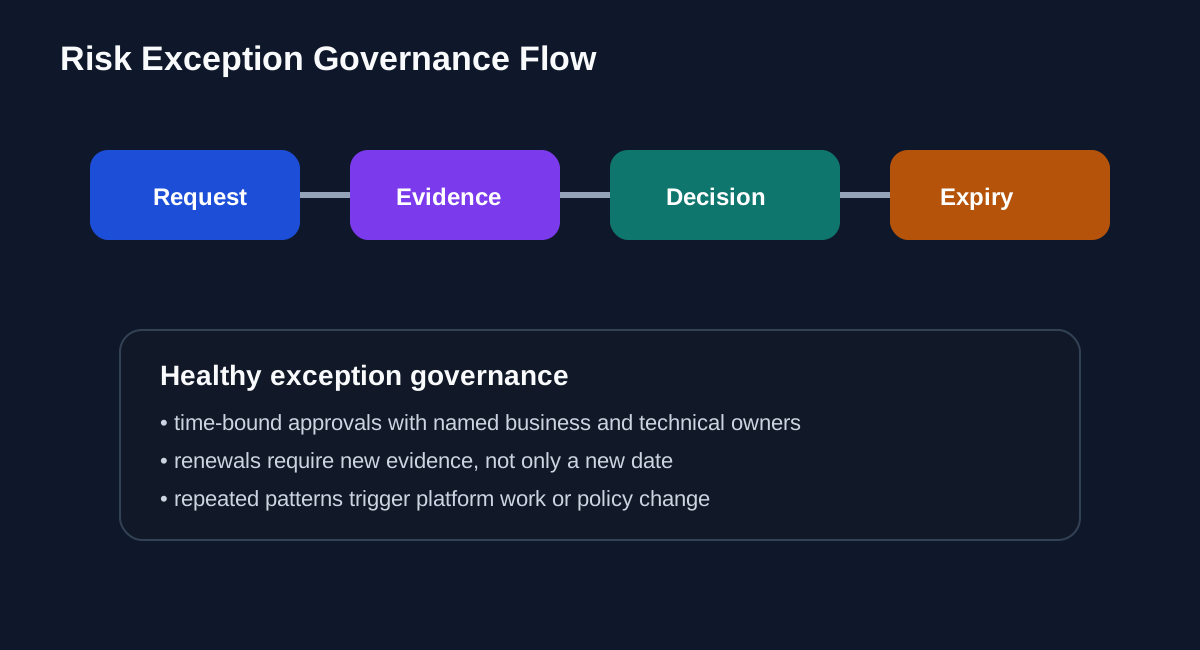
What this page focuses on
This page is the operating layer of exception governance:
- who can approve what;
- what evidence must exist before approval;
- when renewals are allowed;
- how exception data becomes leadership signal instead of ticket noise.
For the shorter conceptual explanation, start with Risk Acceptance, Exceptions, and Decision Records.
Exception categories worth distinguishing
| Category | Example | Why category matters |
|---|---|---|
| control not yet implemented | a service cannot meet a new baseline before a deadline | may indicate roadmap or platform sequencing issue |
| temporary operational workaround | manual approval replaces automated gate during migration | should have short expiry and compensating telemetry |
| legacy-system constraint | older component cannot support the required control yet | needs explicit modernization or retirement plan |
| business-accepted residual risk | leadership chooses to ship with known exposure | requires clear business ownership and time-bound acceptance |
| emergency exception | incident response or urgent restoration bypasses normal policy | must be backfilled with review and closure actions |
Minimum approval package
A request should not be approved without:
- system name and criticality;
- business owner and technical owner;
- control or policy requirement being missed;
- plain-language risk statement;
- why the standard cannot be met now;
- compensating controls already in place;
- expiry date and review date;
- closure plan or milestone;
- proposed approver.
Approval matrix pattern
| Risk shape | Typical approver | Notes |
|---|---|---|
| low blast radius, short-lived, strong compensating controls | engineering manager or delegated control owner | still requires registration and expiry |
| medium blast radius or cross-team impact | Product Security manager / platform owner + business owner | co-approval reduces silent risk transfer |
| high blast radius, internet exposure, sensitive data, or repeated renewal | director / designated risk board | should include explicit leadership decision record |
| emergency operational bypass | incident authority + follow-up approver | must be reviewed after stabilization |
Renewal rules that prevent decay
Renewals should require new evidence, not only a new date.
Require the requester to show:
- why the blocker still exists;
- what changed since the previous approval;
- whether compensating controls improved;
- whether the standard or golden path needs adjustment instead.
Escalate when:
- the same service requests the same exception repeatedly;
- many services need the same exception;
- the exception is becoming part of normal delivery.
Compensating controls that justify short exceptions better than others
High-value examples:
- narrower scope or smaller rollout blast radius;
- additional logging and alerting on the exposed path;
- manual approval or four-eyes review on the risky action;
- temporary disablement of the most sensitive capability;
- stronger monitoring on the identity or environment involved.
Weak examples:
- “the team will be careful”;
- “production is internal only” without proving trust boundaries;
- “we will fix it next quarter” with no tracked milestone.
Exception board operating rhythm
| Cadence | Focus |
|---|---|
| Weekly or bi-weekly | urgent approvals, expiring exceptions, stuck renewals |
| Monthly | concentration, repeated categories, overdue closures |
| Quarterly | policy updates, platform investments, retirement of bad patterns |
What leadership should see every month
At minimum, report:
- total active exceptions;
- exceptions expiring in the next 30 / 60 / 90 days;
- oldest active exceptions;
- repeated exception categories;
- teams or services holding the most residual risk;
- renewals approved vs closed exceptions.
Good exception hygiene signals
You are probably doing this well when:
- the number of renewals is lower than the number of closures for the same category over time;
- recurring exception themes lead to new platform defaults or standards updates;
- teams know the approval path and required evidence before the deadline panic starts;
- leadership can name the top residual risks without reading raw tickets.
Best cross-links
- Risk Acceptance, Exceptions, and Decision Records
- Policy Exception Governance Pack
- Leadership Metrics Pack for Product Security
- Secure Defaults and Golden Paths for Product and Platform Teams
Suggested reference links
- NIST SSDF — https://csrc.nist.gov/pubs/sp/800/218/final
- OWASP SAMM — https://owasp.org/www-project-samm/
---Author attribution: Ivan Piskunov, 2026 - Educational and defensive-engineering use.